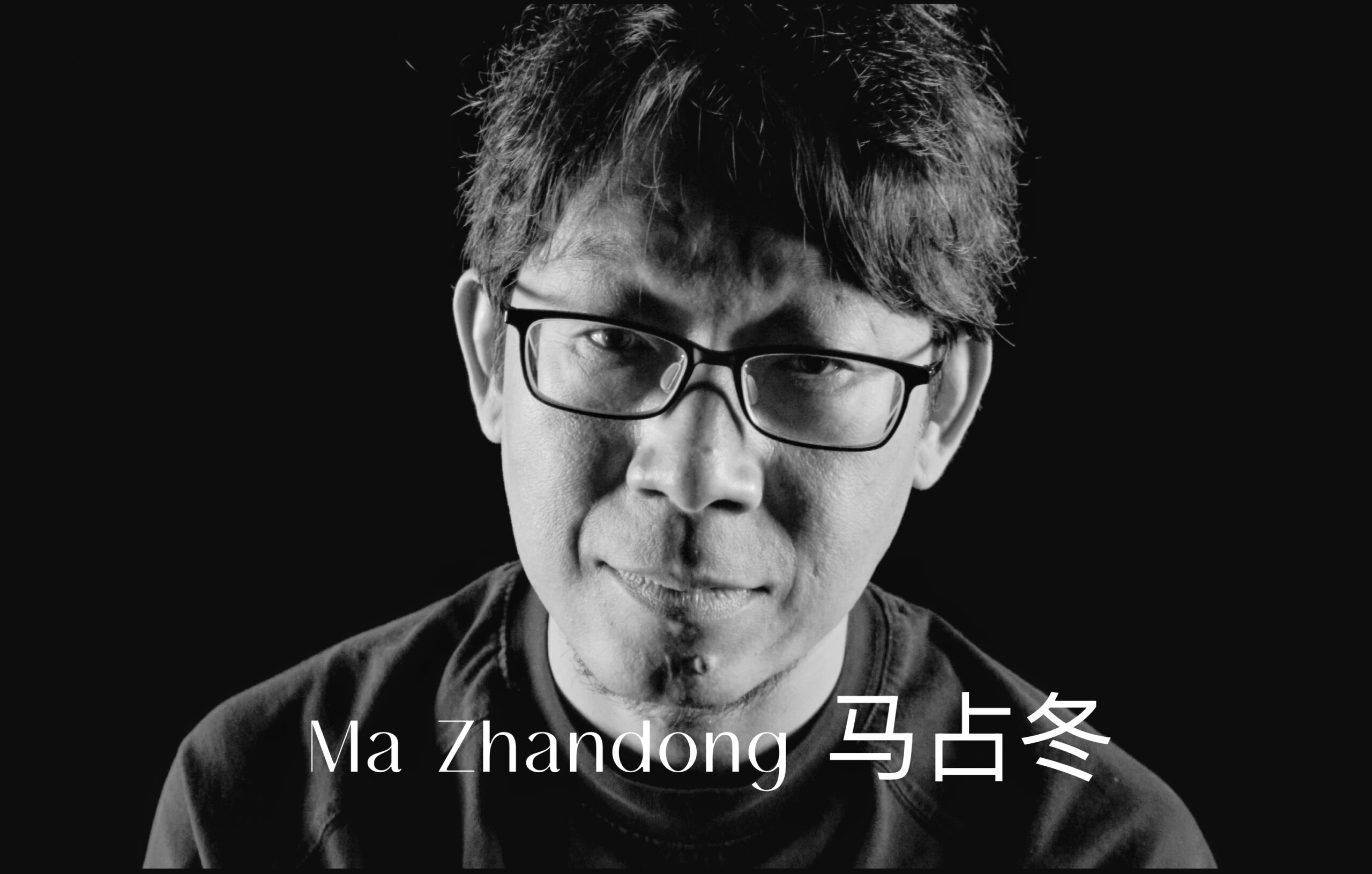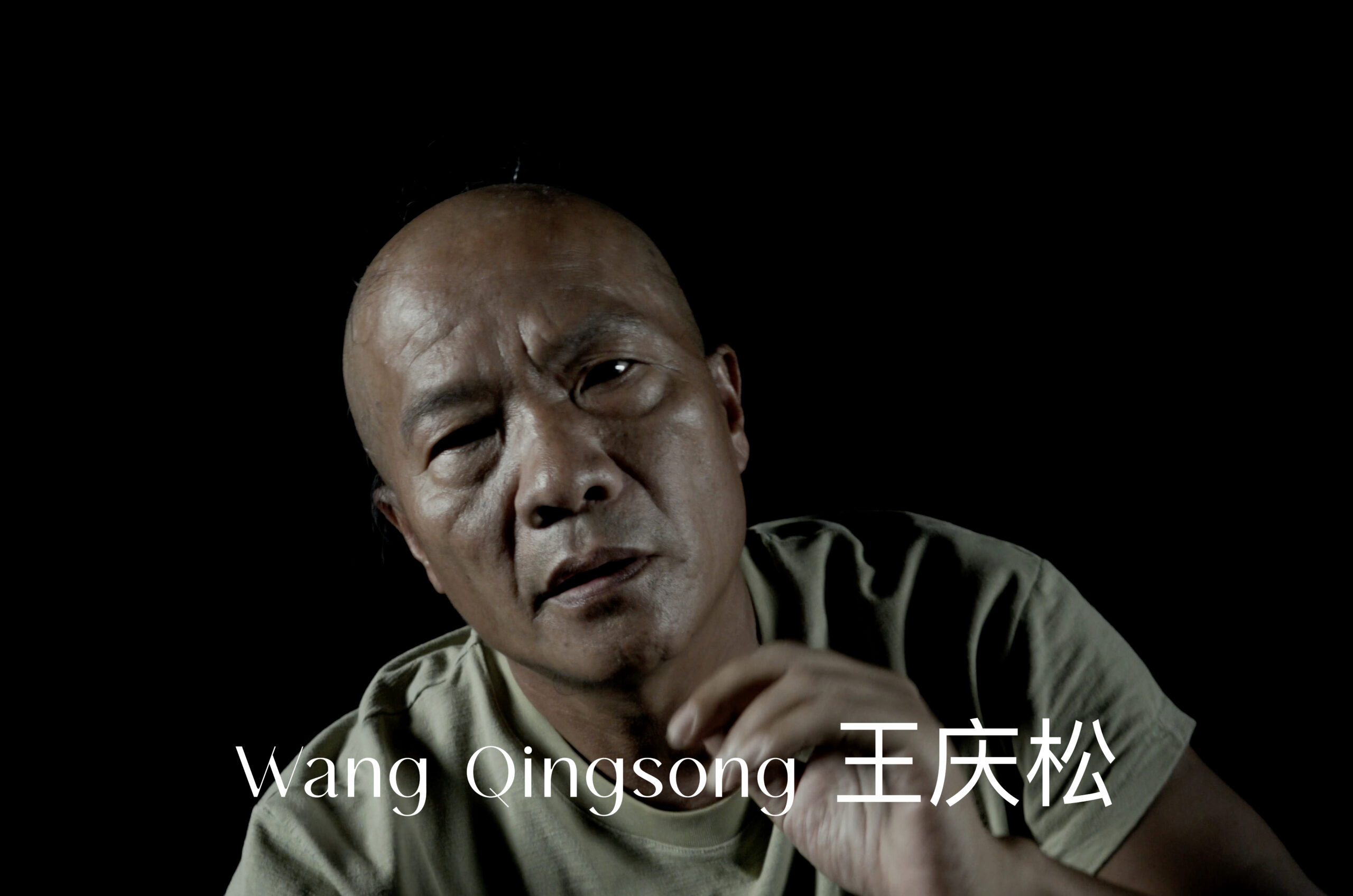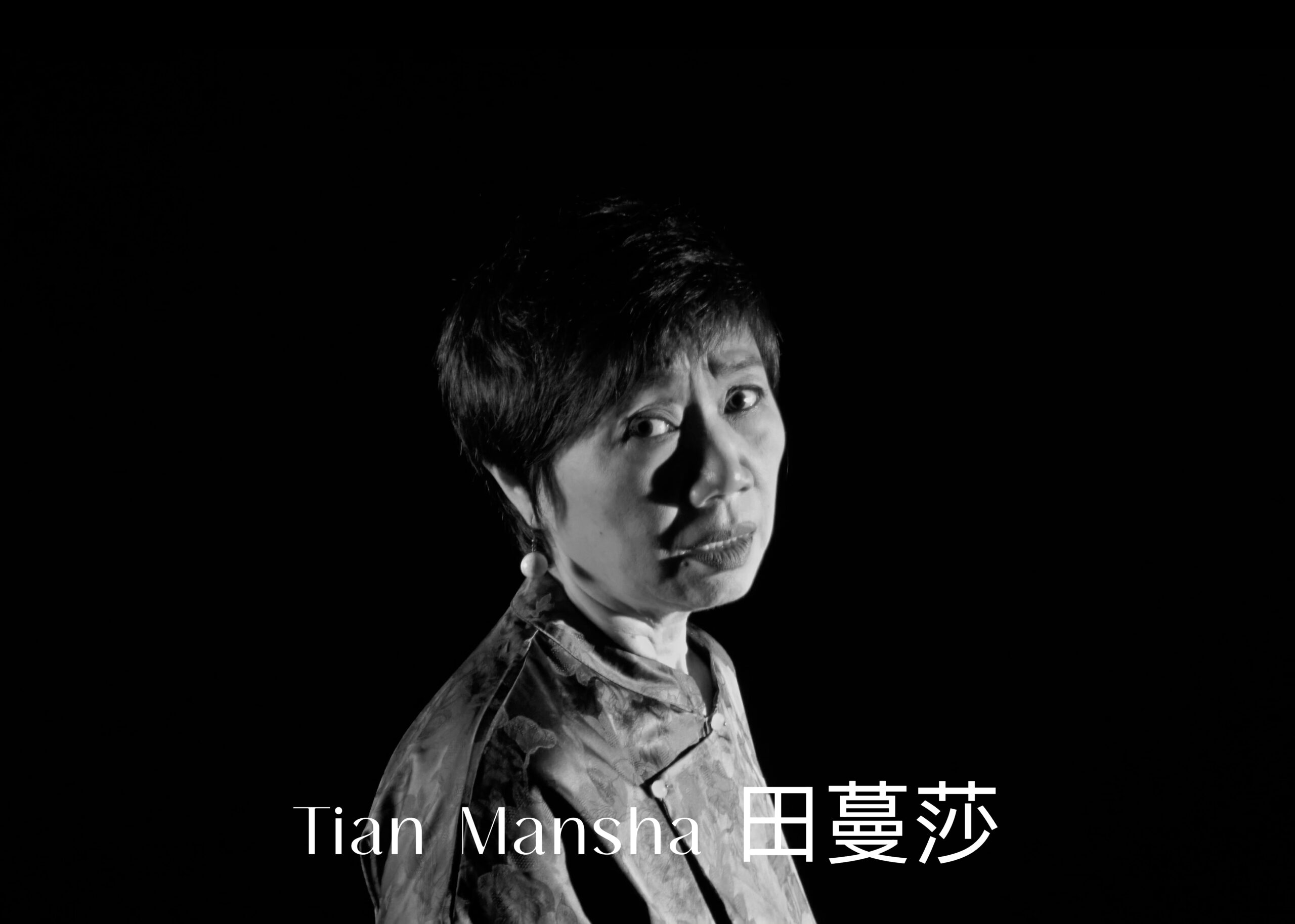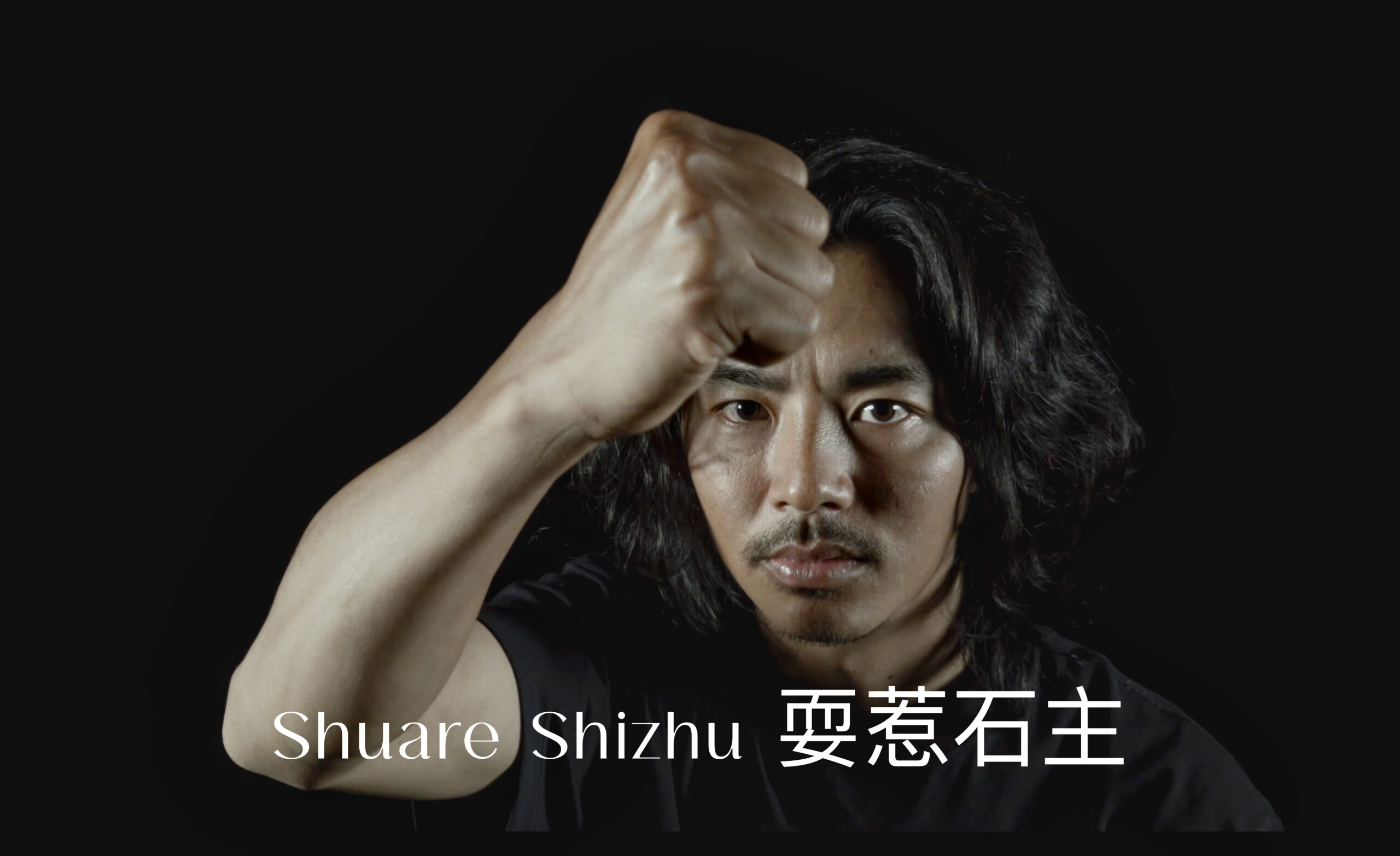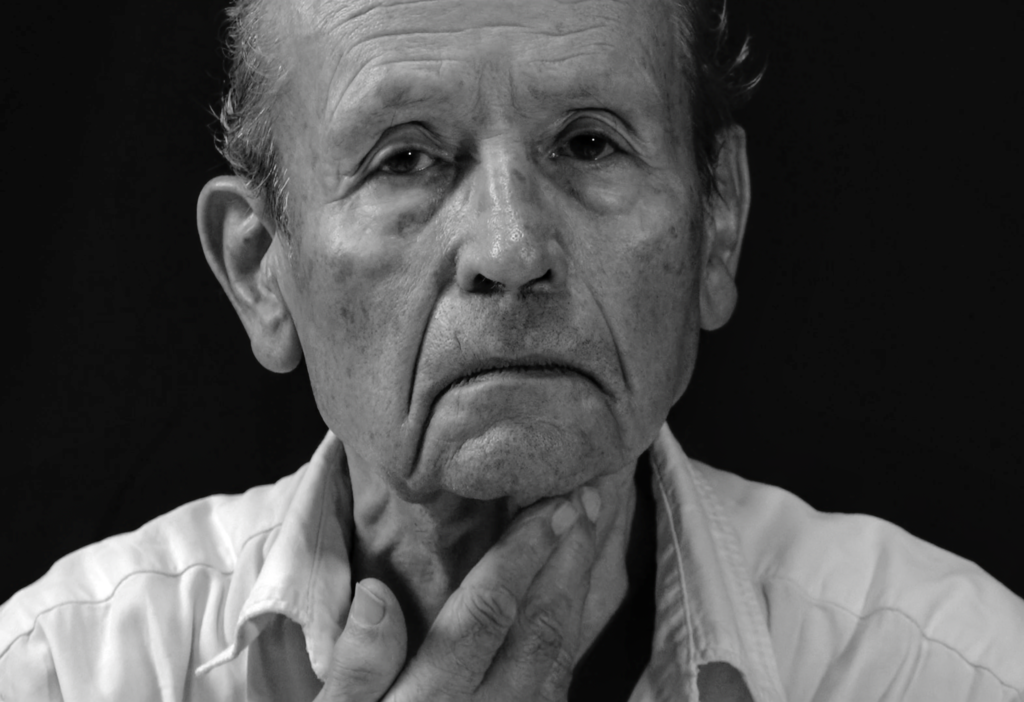
Poet, essayist, founder and director of William BLAKE & Co. publishing.
« And there are indeed moments when a man stands before you, calm and
clear against the backdrop of his splendor.
These are rare celebrations that you will never forget.
This man, now, you love him.
That is to say, you take care, with your tender hands,
to trace the contours of his personality
as you perceived it at that moment. »
Rainer Maria Rilke – Notes on the Melody of Things –
I film his face as delicately as possible. As if I were holding it in the palms of my hands.
I speak to him with confidence.
There is no poet, no great writer, no exceptional essayist, no videographer or director. There are two men, one offering the nakedness of his gaze and the other his full attention.
The camera rolls silently, its eye consumes.
I do not know Jean-Paul MICHEL, other than having read him with astonishment and admiration.
He resembles what he writes; he is upright, forward, angry, and luminous with intelligence.
In daily life, he speaks a lot. A mastered language. He is animated, attentive, precise. He hurries. You can feel that he absolutely rejects the softness and boredom of conventional exchanges.
He sets the bar high, for himself and for others.
He goes into the city, a bit floating, like a stranger to the bustle and vain fever that seems to have struck everyone. He stands firmly where it is not easy to stand, in the realm of the highest demands and great clarity.
This is what I perceive in his gaze which, in front of the camera, does not shy away but emerges and confronts, coming from darkness and night, from hours of long suffering, from relentless study, from books, from poetry, from that deep song that haunts him and now constricts his throat.
I film someone I do not know, yet who offers his face to the black well of the lens. A gift made with strength, pride, tenderness, firmness, and that complete despair which alone allows one to approach the searing blaze of living.
He is ardent.
This man ardently says no to resignation, no to the cursed life, yes to violent beauty, to the outstretched hand, to friendship, to the fire within, to what resists today’s nihilism and ominous predictions.
I see him, isolated by the projector’s light, in the midst of the immense table covered with hundreds of books, documents, letters, files that cannot wait, there, in this Bordeaux warehouse of William Blake & Co. where he often works. The desk resembles a uniform white expanse, a sea of paper where the poet has definitively set sail and navigated towards his distant horizons.
This ocean, or rather, this mountain of paper reminds me of that anecdote, often told. It concerns Frison-Roche, aptly named.
As a young mountaineer, he finds himself stuck under a passage that seems impassable. He persists. His strength abandons him. He hears from afar in the valley, the church bell, the bells of a herd, the world goes on, indifferent to his drama. He gathers his last strength and finally passes.
This is the effort of a man to remain standing.
Jean-Paul MICHEL has crossed the passage, he is a man standing. He knows there is no turning back for him.
He stands on the summits, at the precipice of himself.
Heddy MAALEM
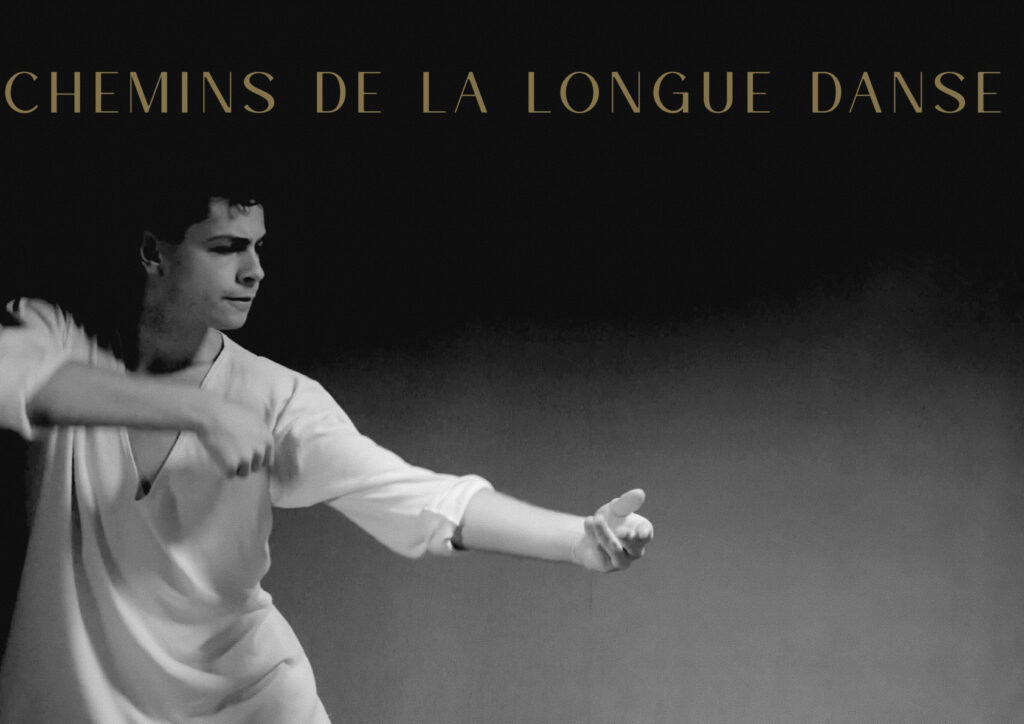
I have never encouraged my son Soleyman to dance. I remember one day during his early childhood, as he imitated our stretching movements, my wife and I exchanged a glance, sharing the same intuition.
A few years later, as a young teenager, he followed the dancers of my play « In Praise of the Mighty Kingdom » everywhere. With generosity and kindness, they taught him the basics of movement and, without realizing it, ignited a flame that soon became a burning passion waiting for that rush of air to fuel his entire life.
Today, as he prepares for a philosophy exam, he continues to dance after training in movement in a way that is both eclectic and wise.
I see him evolving. I see him refusing to follow the beaten path and preferring the difficult road to new heights.
I see him grappling with so many questions: how to live in this world? How to think about it? How to find a place to dance in it? Why and for whom?
He is right to reflect, to exercise his discernment without rushing, and to think like Emily Dickinson:
How exhausting – to be – someone!
How ordinary – like a frog –
To utter one’s name – throughout June –
In the marsh that admires!
What I perceive of art in general and dance in particular seems, for the most part, to partake in the dereliction and confusion we find ourselves in.
What echoed like a rallying cry from the great Pina Bausch: « Dance, dance, otherwise we are lost! » seems to have been interpreted as an invitation to all sorts of contortions. At best, it leads to virtuosity that is abyssally empty; at worst, it results in courtly dances, rebels stamped with the labels of the day, subject to the prevailing winds that have blown the fetid air of a bottomless pit of foolishness for too long.
William Blake, already struggling with « these dirty satanic mills, » those very same that have led to our devastation, wrote:
Bring me my burning gold bow:
Bring me my arrows of desire:
Bring me my lance: O clouds, unfold!
Bring me my chariot of fire!
I will not cease the mental battle…
My son is a fighter.
I trust him. I believe that he and his generation will invent new means, question the notion of spectacle, create new forms of representation that are deeper, more sensitive, more thoughtful, more archaic!
Unless we wish to lose ourselves entirely, we must return to books, to reading, to manuscripts, to the earth, to animals, to Nature in sum; we must return to the tangible, seeking a just gesture that thinks, a proper distance between people, a learning of the gaze. We must return to the source, to contemplation, to song, to poetry, to verticality.
Otherwise, we will continue to march towards our demise, and our children will be left to dance on the volcano of our futility.
Defend yourself, sublime Beauty of the given world! Defend yourself, violent Beauty!»
Jean Paul MICHEL
At the request of the Honin Art Center in Chengdu, the art center that hosted my exhibition: “Mortal Beauties,” I filmed several artists from Sichuan.
I was very fortunate. They were all talented.
We have only an uncertain idea from our old Europe of what China holds in terms of truly valuable artists, in all fields of a vibrant artistic activity that is developing, a bit like everywhere, despite everything.
I wasn’t really reassured.
How was I going to get bodies in motion that are not used to moving? Would something happen in front of the camera lens in the brand new studio of Honin run by the friendly Quan, an adept technician and photographer, wholly dedicated to the success of my work, with whom we quickly set up simple lighting, the black background that I need, and the few technical details essential for the quality of the shot.
I was sent their portfolios, their website link, videos that I took a quick look at knowing from experience that things play out in real encounters and the ensuing vibes, good or bad.
So I filmed:
TIA Mansha, the Chinese opera actress who never took off her mask but ultimately conveyed the pain of a memory,
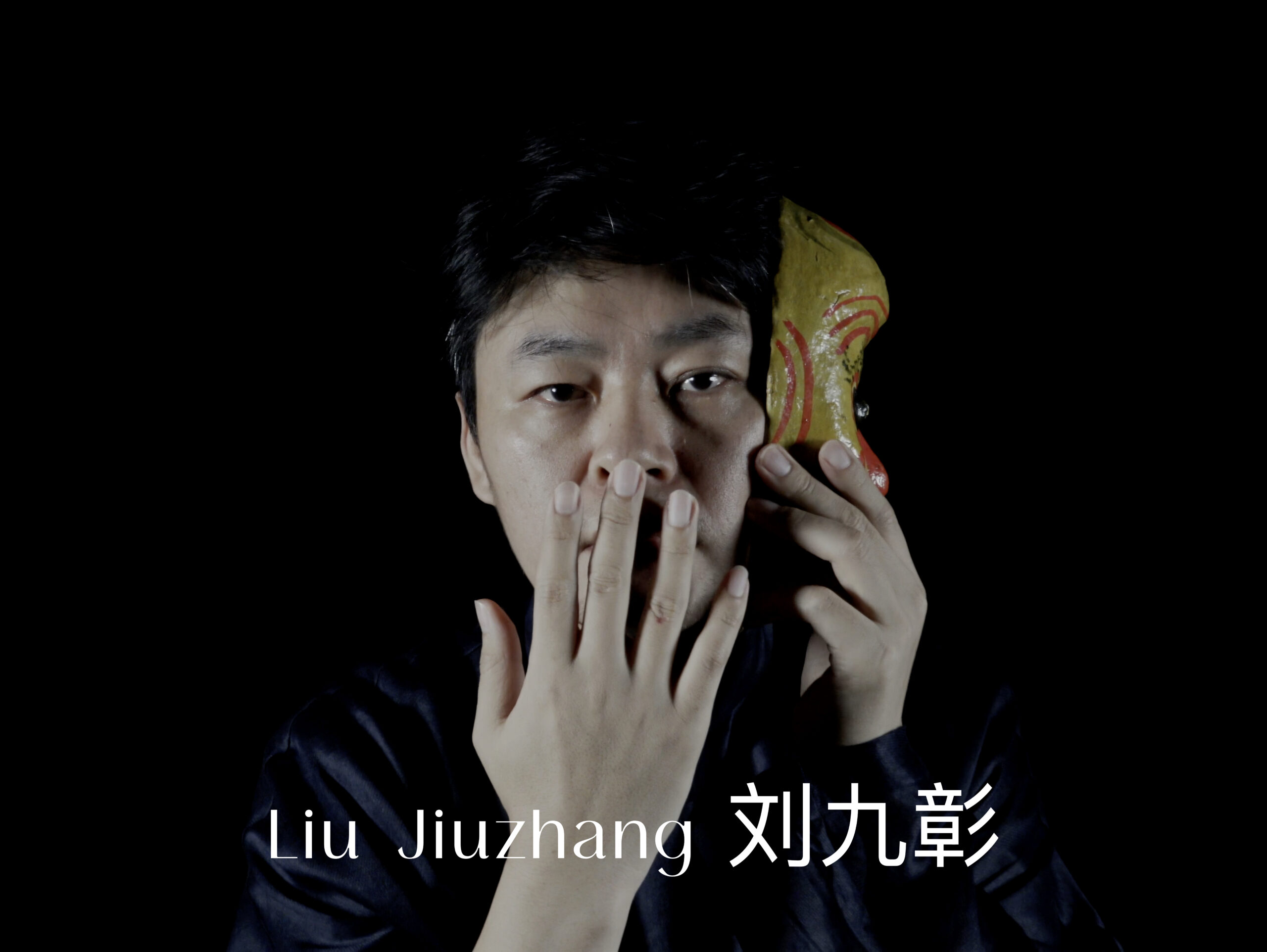
LIU Jiuzhang, the great Mongolian musician gracefully moving his beautiful hands, confessing that he would have liked to dance.
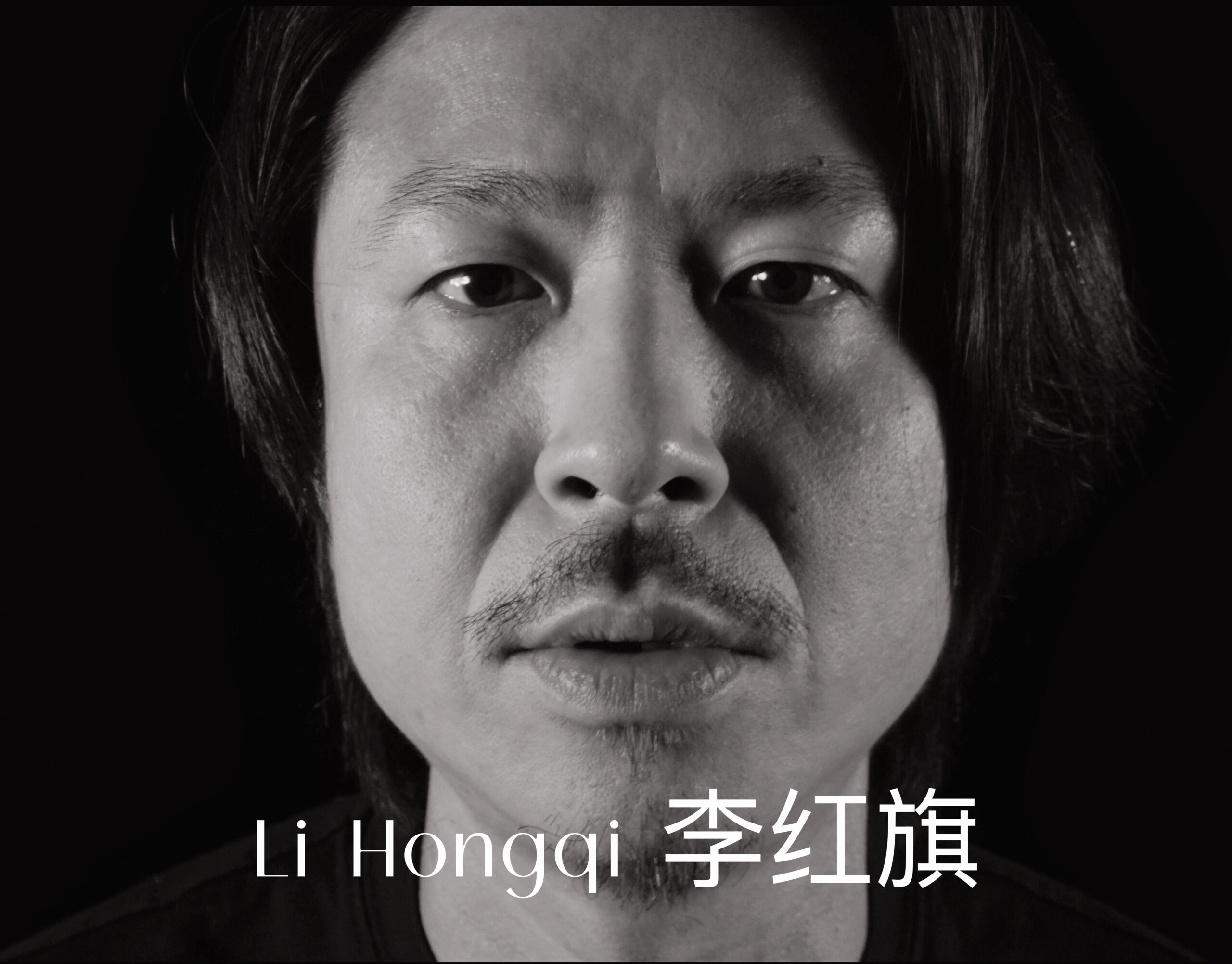
LI Hongqi, a shy and popular reggae singer, a fervent believer whom I ended up filming in an anguished prayer directed to the heavens of the studio.
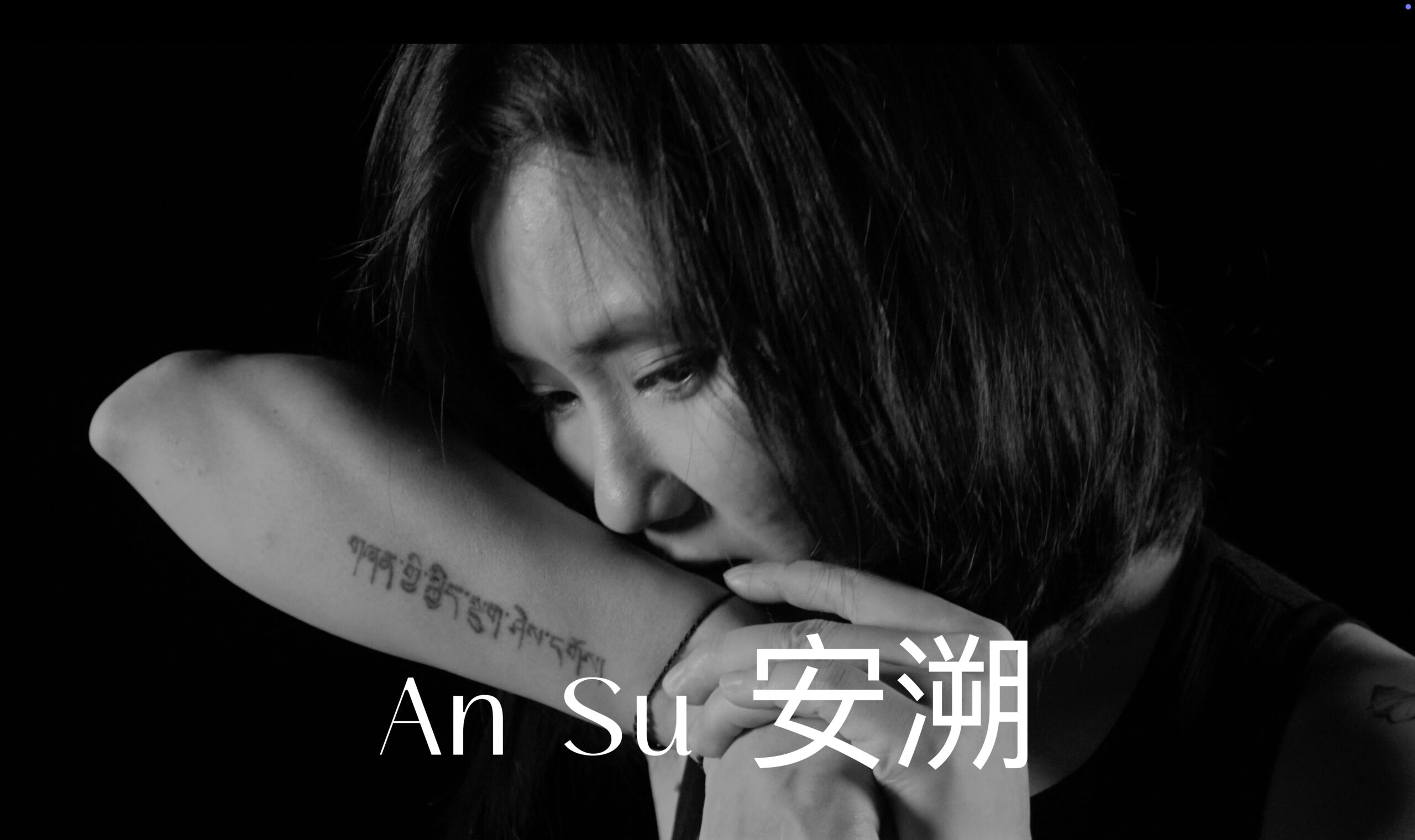
AN SU, photographer and mountain lover, especially climbing, with a taste for risk that bodes well for her future.
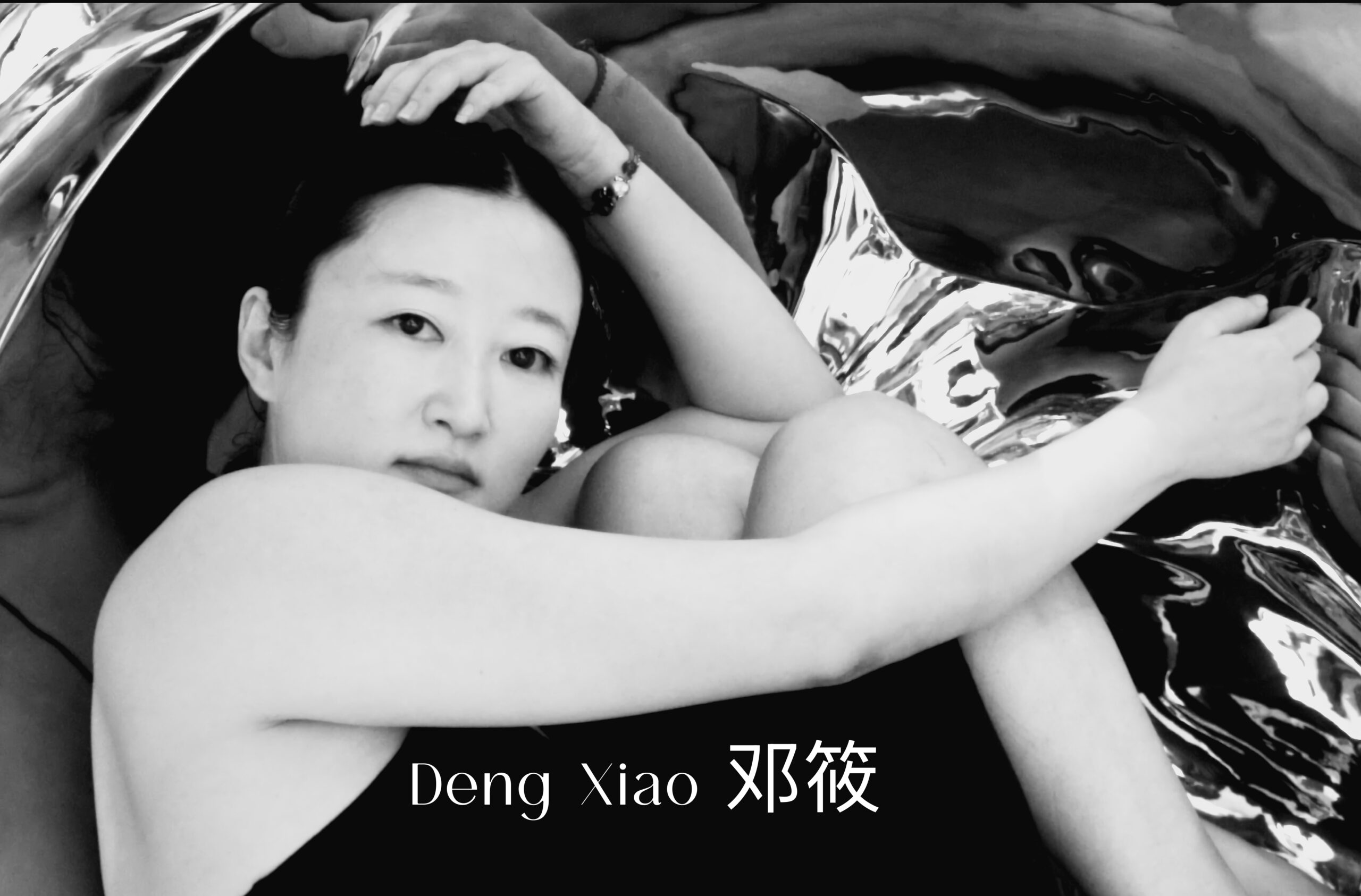
DENG Xiao, an astonishing sculptor, inhabited by darkness, stellar brightness, and the depth of matter.
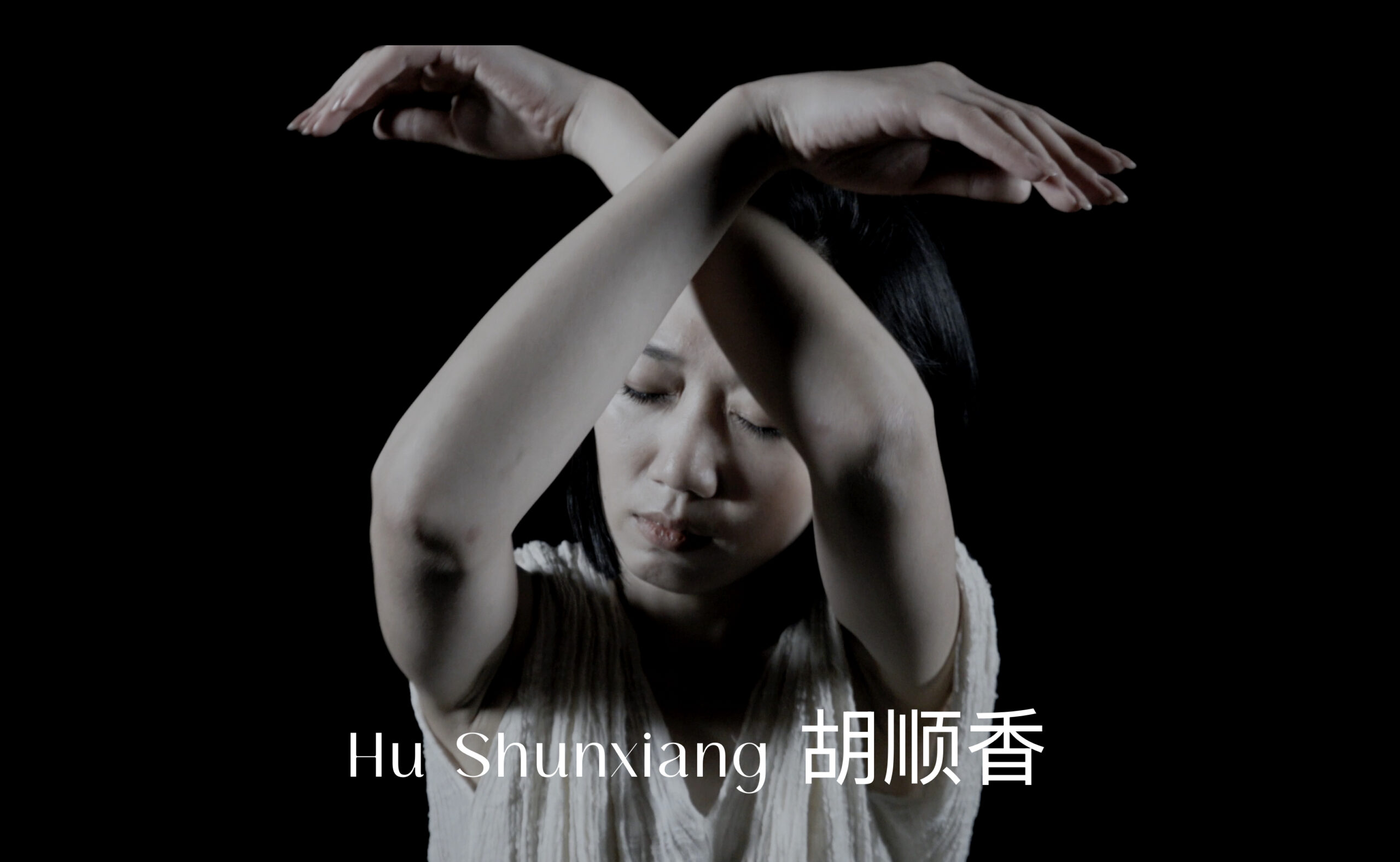
HU Shun Xiang, a talented painter, all antennas out, black eye, radiating gentleness, sensuality, and long patience.
WANG Qinsong, a renowned photographer, who, like a Rembrandt, multiplies his presence in his own works. An accomplished art of staging, playful and sincere. Gift and withdrawal.
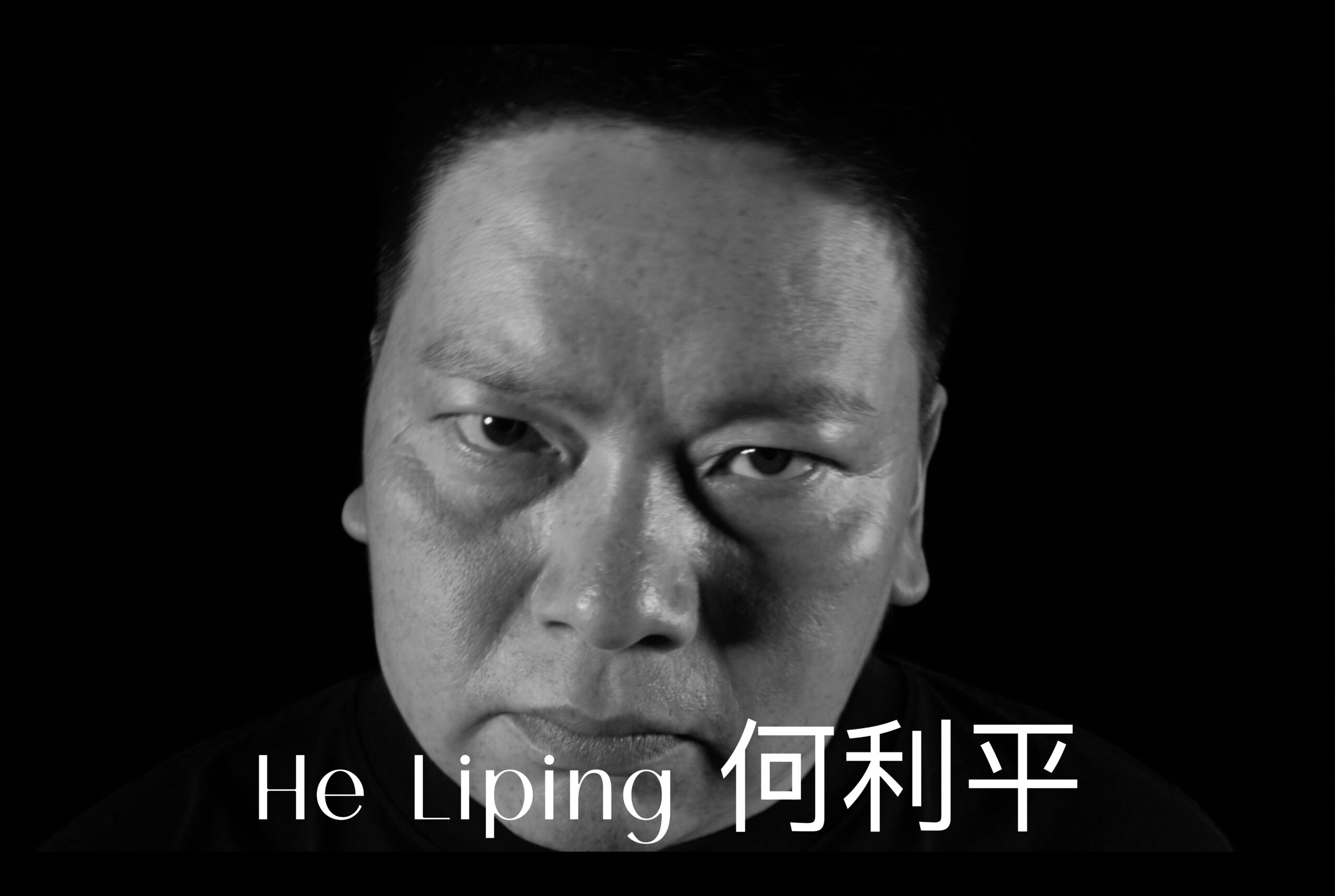
HE LiPing, a performer and rapper, whom I filmed in his obstinate refusal to open up, ultimately creating a portrait.
SHUARE Shizu, the young Yi painter, quick, skilled in evasion, wholly absorbed in his overwhelming passion.
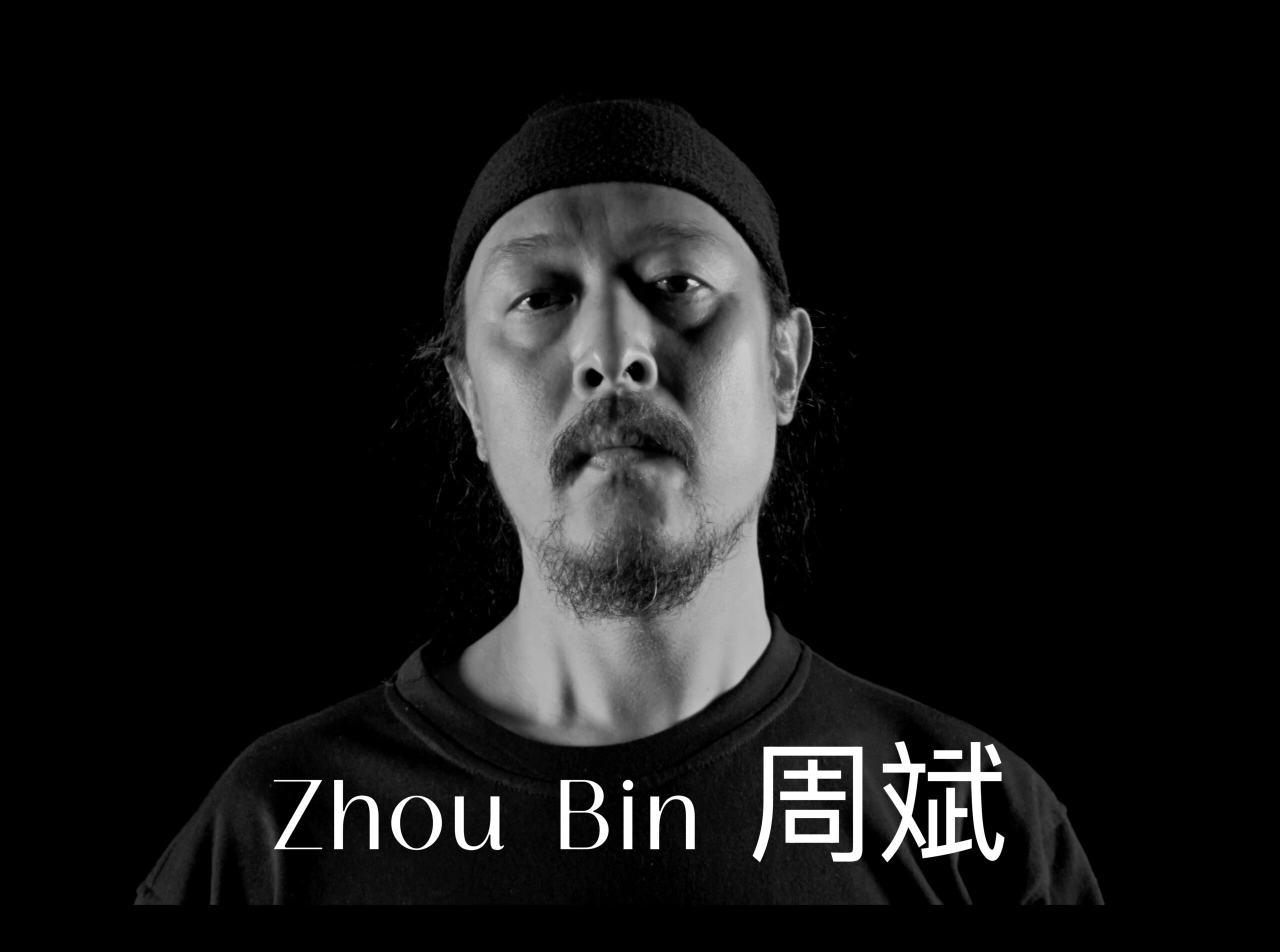
ZHOU Bin, performer and plastician, caught in the imperious surge of a burning energy.
MA Zhandong, finally, a filmmaker and documentarian, surprised to find himself face to face with this lens he has used so much. Stirring in its honesty.
All true artists, deeply engaged in their practice, some in full success, others promising, all, in any case, cordial, modest, and unpretentious.
It is hard to succeed in capturing someone’s portrait. Creating danced portraits, with few exceptions, has never seemed out of reach to me.
I was apprehensive about filming people who are not “of the body.” I was mistaken. Perhaps it is because they were all, in their own way, engaged in a practice that involves the whole being, and thus, the knowledge of self and others, making access to their own sensitivity potentially easier.
How strange it is when you think about it.
What are these portraits? What was my attempt?
To try to capture the light and shadows of men and women who have all dedicated their lives to doing the same thing.
To paint, to film, to photograph, to sing, to compose, to sculpt…the life, the dread, the unspeakable possibility of murder, the epiphany of faces, the darkness within, the sharp edge of desire, and all these bodies sinking.
To construct as best as we can the verticality we are trying to elevate against the absurd. To defend the Beauty that must be saved because, everywhere, it is being killed.
Heddy MAALEM
应成都的红印艺术中心——当时举办我展览《致命之美》的艺术机构——之邀,我拍摄了几位四川的艺术家。
我非常幸运,他们都很有才华。
自我们这片古老的欧洲,对中国所蕴藏的真正有价值的艺术家,其实所知寥寥。可事实上,在一个创作蓬勃的艺术世界里,各种艺术形式都在发展,就像世界上其他地方一样,尽管困难重重。
起初我并不太踏实。
我如何才能让一些原本未必习惯于身体律动的人去动起来?在红印那间崭新的摄影棚里,面对镜头,他们会发生些什么吗?这个摄影棚由亲切的泉君掌管——他既是技师又是摄影师,手艺娴熟,全身心投入于我工作的成功。我们很快就布好几盏简单的灯,竖起了我必需的黑色背景,并调试完拍摄质量所必备的一些技术细节。
在此之前,他们的作品集、网站链接、一些视频都已传来。——我只是快速浏览了一下,因为凭经验我知道,一切最终取决于现场相遇的瞬间,以及随之而来的共振,不论好坏。
于是我拍摄了:
田蔓莎——川剧演员,她从未卸下面具,但终究还是以表演让一个痛苦的记忆浮现;
刘九彰——那位伟大的蒙古族音乐家,他的双手舞动优雅,还向我坦言,他其实希望自己能跳舞;
李红旗——害羞却受人喜爱的雷鬼歌手,信仰虔诚,我最终拍下了他在摄影棚里向天空诉说的那段焦灼的祈祷;
安溯——摄影师,热爱高山,尤其迷恋攀岩,嗜险的性格预示着她广阔的未来;
邓筱——惊异的雕塑家,她的作品饱含黑暗、星辰的闪耀与物质的深渊;
胡顺香——富有才华的画家,全身都是触角,黑眼睛,光芒中透出温柔、感性和无尽的耐心;
王庆松——著名摄影家,他仿佛如伦勃朗一般,把自己反复置入作品之中。其布景技艺炉火纯青,既游戏,又真诚。施予与抽离;
何利平——行为艺术家、说唱歌手,我只能拍下他顽固的拒绝与抗拒,这最终也形成了一幅肖像;
耍惹石祖——彝族青年画家,灵动、善于闪避,沉迷于自己那股汹涌的激情;
周斌——行动艺术家与造型艺术家,被一股炽烈而无法遏制的能量推涌着;
马占东——电影人、纪录片导演。突然发现自己置身于那个他无数次使用过的镜头之前,竟那样震撼人心的真诚。
他们都是地地道道的艺术家,深深投入于自己的实践中。有些已经大获成功,另一些则前途光明。无论如何,他们都热情谦和,不摆架子。
要成功塑造一个人的肖像并不容易。而我一向觉得(除了少数例外)拍摄舞动的肖像并非不可企及。
我曾担心,要拍摄一些“不属于身体”的人。其实我错了。或许正因为他们各自在各自的实践中,无一例外都牵涉到全人的投入,这自然包含了对自我和他者的认知,也让他们更容易抵达自己的敏感与真诚。
这真是件奇异的事情,仔细想来。
这些肖像究竟是什么?我的尝试究竟是什么?
只是努力去捕捉那些男人与女人们的光影,他们都将一生奉献于同一件事:
去描绘、去拍摄、去摄影、去歌唱、去创作、去雕刻……生命、惊悸、那难以言说的杀机、面庞的启示、内在的黑暗、欲望的锋芒,以及所有下沉的身体。
尽所能地去建构那条笔直的竖线,好让我们在荒谬面前竖立起来。
去守护必须被拯救的美,因为在各处,它正不断被毁灭。
—— 赫迪·马拉姆
Collaborating Artists / 驻留合作艺术家/音乐人
An Su 安溯
Personal website: https://ansuginkgo.com/information
Reference website: https://www.thepaper.cn/newsDetail_forward_19646194#
Reference website: https://mp.weixin.qq.com/s/NRdDr8pwITJ0AhD17bxkdg
Deng Xiao 邓筱
Personal website: https://www.xiaodengart.com/about-me/
Reference website: https://2nd.annualmetaverseart.com/artist/deng-xiao/
He Liping 何利平
Reference website: https://mp.weixin.qq.com/s/wK0d_PyfJOV3lN_mI2h4UQ
Reference website: https://mp.weixin.qq.com/s/snFU765ICCU-8J8F11VDdw
Reference website: https://mp.weixin.qq.com/s/OTn_Ua8foet4NK3PzGpbLQ
Reference website: https://mp.weixin.qq.com/s/T16pjtUlSEkhLAkBz_R-6A
Hu Shunxiang 胡顺香
Personal website: https://hushunxiang.com
Reference website: https://website-leogallery.artlogic.net/artists/595-hu-shunxiang/biography/
Reference website: https://hdmgallery.com/cn/artists/75-hu-shunxiang/overview/
Reference website: https://www.leogallery.com.cn/usr/library/documents/main/artists/595/hu-shunxiang-cv-leo-gallery.pdf
Li Hongqi 李红旗
Summary of musical works: https://music.163.com/#/playlist?id=7338215575
Reference website: https://www.baike.com/wikiid/6943080059717670176?anchor=1
Reference website: https://mp.weixin.qq.com/s/eUfLqDlO5rNmvnjoFvuMXQ
Reference website: https://mp.weixin.qq.com/s/Agp-DzhDUXSc070yOvA_Jg
Liu Jiuzhang 刘九彰
Reference website: https://baike.baidu.com/item/刘九彰/7111558
Reference website: https://www.leogallery.com.cn/cn/exhibitions/135/works/artworks-4031-liu-jiuzhang-moth-2024/
Ma Zhandong 马占冬
Reference website: https://www.douban.com/personage/35499290/
Reference website: https://mp.weixin.qq.com/s/kxn9ZQm4YP34x9fVE2FYug
Reference website: https://www.chinesemovies.com.fr/cineastes_Ma_Zhandong.htm
Shuare Shizhu 耍惹石主
Reference website: https://www.theworldofchinese.com/2024/01/beyond-the-frame-shuare-shizhus-world-in-wide-strokes/
Reference website: https://mp.weixin.qq.com/s/83e2Mhn6n6q99BgYkbaKKg
Reference website: https://mp.weixin.qq.com/s/jqMjdlse1kAITOgmkTiGBA
Tian Mansha 田蔓莎
Reference website: https://aefestival.gr/tian-mansa/?lang=en
Reference website: https://www.impulstanz.com/en/artist/id1577/
Reference website: https://www.geisteswissenschaften.fu-berlin.de/en/v/interweaving-performance-cultures/fellows/fellows_2011_2012/mansha_tian/index.html
Reference website: p134-p143
Wang Qingsong 王庆松
Personal website: http://www.wangqingsong.com/index.php?option=com_content&view=article&id=6&lang=zh
Reference website: https://photographyofchina.com/author/wangqingsong
Reference website: https://www.chinesenewart.com/chinese-artists8/wangqingsong.htm
Zhou Bin 周斌
Reference website: https://www.artlinkart.com/cn/artist/overview/836bvvm</
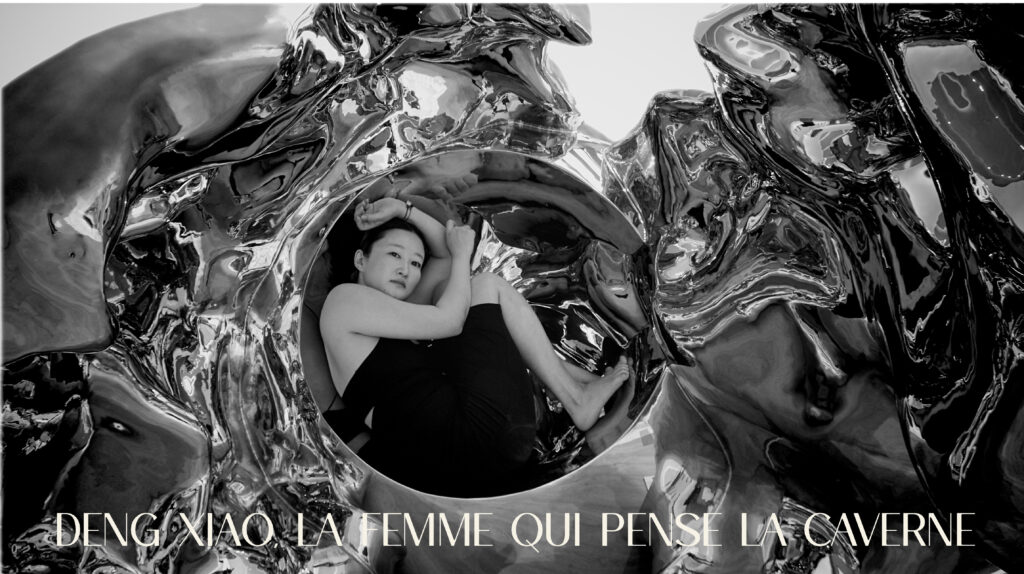
Deng Xiao already has a significant body of work behind her. Everything seems to be directed towards a futuristic elsewhere, objects appearing as if from distant galaxies, polished metal surfaces with tormented geometry as if having traversed light-years before arriving here, like enigmatic messages addressed to us.
A prolific, spectacular, sometimes gigantic body of work that, when placed in a public space, projects it towards a future that is not so much radiant, but certainly bright, maybe cold, and surely worrying even if it seems filled with promises of unprecedented technological achievements.
Deng Xiao is preoccupied with the enigma and presents it to the somewhat astonished eyes of a public always longing for strange novelties, under the charm of the brutal yet elegant mysteries she sculpts from strange materials.
She impresses with the energy deployed and the depth of her gaze, capable of reaching further than the Milky Way, into the cosmic darkness, where nothing echoes, where night meets night, and where black is no longer a color.
Yet, upon closer examination, perhaps the exceptional art of this discreet young woman, dressed entirely in black, with profound sensitivity, is not aimed towards an interstellar future. Her shyness is merely apparent. She is turned inward, constantly attuned to what haunts her and which she strives to bring to light: the blackness of the ontological enigma, the shimmering reflection of unresolved questions.
Among these is the origin.
The greatest myth of humanity, the most widespread among the small number that have survived since man became man, is that of the “emergence hole.”*
Animals, humans, living beings emerged from beneath the earth to inhabit it.
In many of her sculptures, Deng Xiao brings the original cave back to life. A shimmering cave, stalactites falling from the celestial vault like solidified lightning struck by the rage of distant beings aiming for our planet no longer entirely blue.
I had the chance to film Deng Xiao, to create her portrait. She arrived in her black attire, a bit panicked at the idea of having to move in front of the camera. I had nothing better to say to her than that if that’s how she felt in the moment, she could pretend to hide, which would, after all, serve as the starting point of a movement.
And that’s what she did, with a consummate sense of shadow and light, so that I hardly needed to do much on that front.
The video was perfect. It conveyed an essential truth.
We come to light, we play with shadows, night ultimately covers everything, including the magnificent, somewhat unreal eyes of Deng Xiao, these eyes that have witnessed the night of the cave to that, infinite, of the stars.
If you have the curiosity to slip inside one of Deng Xiao’s sculptures, you will likely feel many things long forgotten by the adult with tough skin you have become.
A peace, a calm, but also a distorted vision of yourself reflecting on the polished steel surface of this improbable cave.
Perhaps it was the same thing that the distant ancestors of our prehistory sought in the dark caves. Protection from the violence and savagery of the outside, a bit of peace within chaos.
They made fire, likely talked, and then inscribed the first works of art on the walls, projecting their humanity still entangled with the animal they had to distinguish themselves from. At the same time, they attempted to understand death, night, murderous desire, night, and the flames that pierce it, creating strange dances upon the rock.
The night of dreams, frightening and prophetic.
Finally finding the courage to step out into the daylight again, to find the emergence hole through the tortuous path leading to our humanity.
Deng Xiao, in her powerful and ambitious way, does just that and tells us, through the force of her art, what we all refuse to hear: we travel from night to night, we come from the hole of origin, we lose ourselves in the shimmer of the cave, we try to reach the dark sky, once again captives in strange capsules, without understanding anything of our primordial confinement.
Heddy Maalem
邓筱已经拥有了一份相当可观的作品。
她的艺术似乎皆朝向某个未来主义的 »他处 »,那些作品仿佛来自遥远星系的物件:金属表面抛光而冷冽,几何线条扭曲、纠结,似乎穿越了光年的旅程才抵达此地,犹如一封封神秘报文,专为我们而来。
她的创作丰沛、壮观,有时甚至宏大至极,当这些作品进入公共空间时,会将其投射向某种未来——未必光明,却必然璀璨;或许冰冷,定然令人不安,即使它们充盈着前所未有的科技奇迹的承诺。
邓筱关注的是谜团,并将其展示在观众略显惊异的目光之下。人们总是渴望陌生的新奇,而她以奇异材质雕刻出的那些既粗砺又优雅的神秘,深深吸引了他们。
她以磅礴的能量震撼人心,她的目光敏锐而深入,仿佛能穿越银河,在那无回声的宇宙暗黑深处,在夜与夜重叠、黑不再是颜色的尽境之所,找到凝视的支点。
然而,若凝神细察,也许她的艺术并非真的指向某个星际未来。
这位年轻却低调的女艺术家,身着一袭黑衣,气质优雅而感性细腻。她的羞怯只是表象,事实上,她总是朝向自身的内里,默默倾听那些萦绕心魂的幽暗,并努力将之显现:存在之谜的漆黑本源,尚未解答的问题在镜面上闪烁回响。
其中最核心的,便是——起源。
人类最伟大的神话,也是最广为流传、顽强存续于寥寥数个古老传说中的一个,正是 »出现之孔 »的神话。
动物、人类与万物,皆自地底之下穿出,来使大地繁盛。
在邓筱的许多雕塑之中,那个最初的洞穴再次复活。那些熠熠生辉的岩洞景象,穹窿上的钟乳石如闪电凝固,是远古存在怒掷向我们不再纯蓝的星球的痕迹。
我有幸为邓筱拍摄,为她制作肖像。
她身着黑衣而来,面对在镜头前要做出动作的想法略显惊慌。我所能对她说的,只是: »如果此刻你觉得必须隐藏,那大可以去演绎隐藏——毕竟,那本身便是动作的开端。 »
她的确如此做了,以极其娴熟的光影掌控来表达,于是几乎无需我再去调整。
画面已然完美,表达了最核心的东西:
我们来到光明之下,与影子共舞,最终夜晚覆盖一切——甚至覆盖邓筱那双微显非凡的美丽眼睛。那双眼睛见证过从洞窟黑暗到群星无垠的漫长夜色。
若你有好奇,亲自进入邓筱的一件雕塑之内,你将感受到那些成人在日常中早已忘却的东西。
一种宁静,一份安详,或是从抛光钢铁的洞穴壁上折射出的那种怪异形象——你被扭曲而陌生地映照出来的自己。
或许,这正是我们的远古祖先曾经在幽暗的洞穴中所寻找的东西:抵御外界暴力与残酷的庇护,以及混沌中片刻的安宁。
他们升起火光,或许交谈,然后在洞壁上留下最初的艺术:那既反映出他们与动物尚未切割的共生状态,也显露出他们急切理解的欲望。
去理解死亡,理解黑夜,理解杀戮的渴望;理解夜色与火焰交织,如何在岩石上播撒出奇异的舞蹈。
梦境之夜——可怖,又带着预兆。
他们终于鼓起勇气,再度走向光天化日,循着那条曲折的通道,找到 »出现之孔 »,走入人性的真正来处。
邓筱正以她独特、雄心勃勃的方式,重演这一切,并以艺术的力量告诉我们所有人,那些我们拒绝听见的事实:
我们从夜走向夜,我们源自最初的黑暗孔穴;我们在洞窟的幻影中迷失,又试图飞升至黯沉星空;然而最终,我们依旧被囚禁在诡异的舱壳之内,从未真正理解过那最初的囚禁。
—— 赫迪·马拉姆
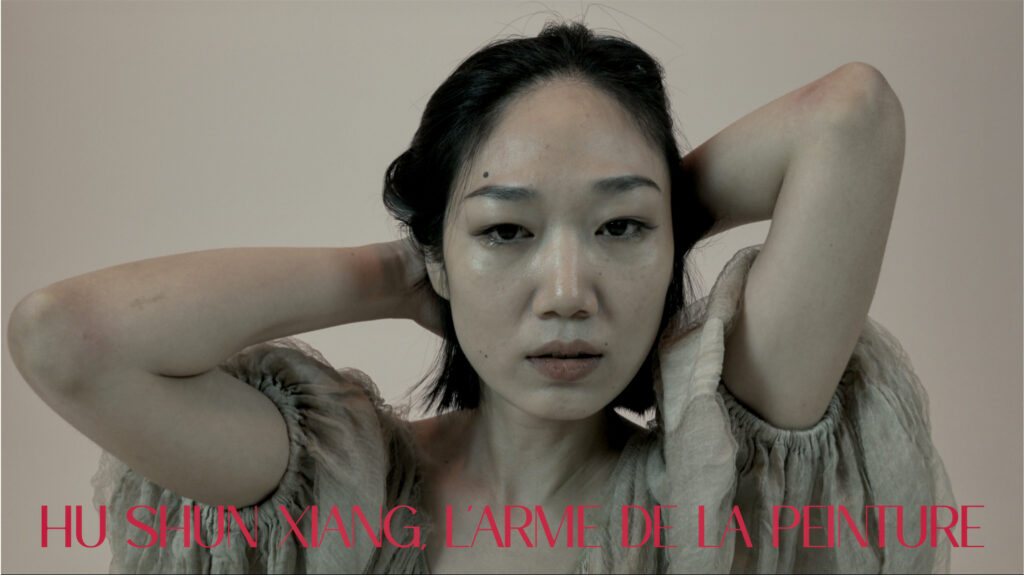
Refined is the word that comes to mind when you see her for the first time. You can sense she feels a bit anxious about the strange prospect of being filmed.
She likely agreed because she is bold and curious, about herself too, of which she will later discover the filmed portrait.
The first take produces something surprising. She wanted to sit on the black felt floor of the studio. Fragile in the persistent light, offering a lost profile to the camera’s devouring eye, turning away, dodging. One might have thought of a shy woman, but towards the end, when she gives her gaze, a determined fighter is revealed, whose eyes reflect an enigmatic black of deep water, filled with ancient wounds from timeless wars.
They fix their gaze on you, seeing you, challenging you to engage in the battle.
The one for the conquest of her friendship, for her to consent to share a bit of herself with you.
A sophisticated duel with foils.
For the gallery, she presents the image of a young woman elegant and laughing, friendly yet somewhat reserved.
To you, she offers the black diamond of her eyes. Like a Sphinx, she waits for you to know how to respond, and perhaps silently to answer the unspoken question posed by the obscure beauty of her gaze.
What? It seems to ask.
Like the ironic title of her painting depicting a brain in weightlessness.
Yours?
To sustain dialogue, one must first listen and give attention. This is true for any genuine friendship.
And first, one must delve into the work of Hu Shun Xiang.
I perceive in the overwhelming sensation that her painting invokes, the omnipresence of a gray background, a great refinement in the execution of the pictorial gesture that reveals, muted violence, shocking reminiscences, sarcasm and irony, applied intelligence, patience, phenomenal intuition, long memory, and fear of the evanescence of all, terror of loss, the rush of desire that floods and disturbs the canvas. A devastating humor linked to great delicacy. Extreme complexity emerging from the depths of a soul long trapped in the troubled current of the river of childhood tears.
Distinction.
Love.
Strength.
Compassion.
Others will situate Hu Shun Xiang’s work in the History of Art. They will likely see influences from Francis Bacon, Renaissance painters, the great millennial Chinese art, of course, and surely other things that her art transcends, absorbs, and restores in a unique and refined expression of pure energy.
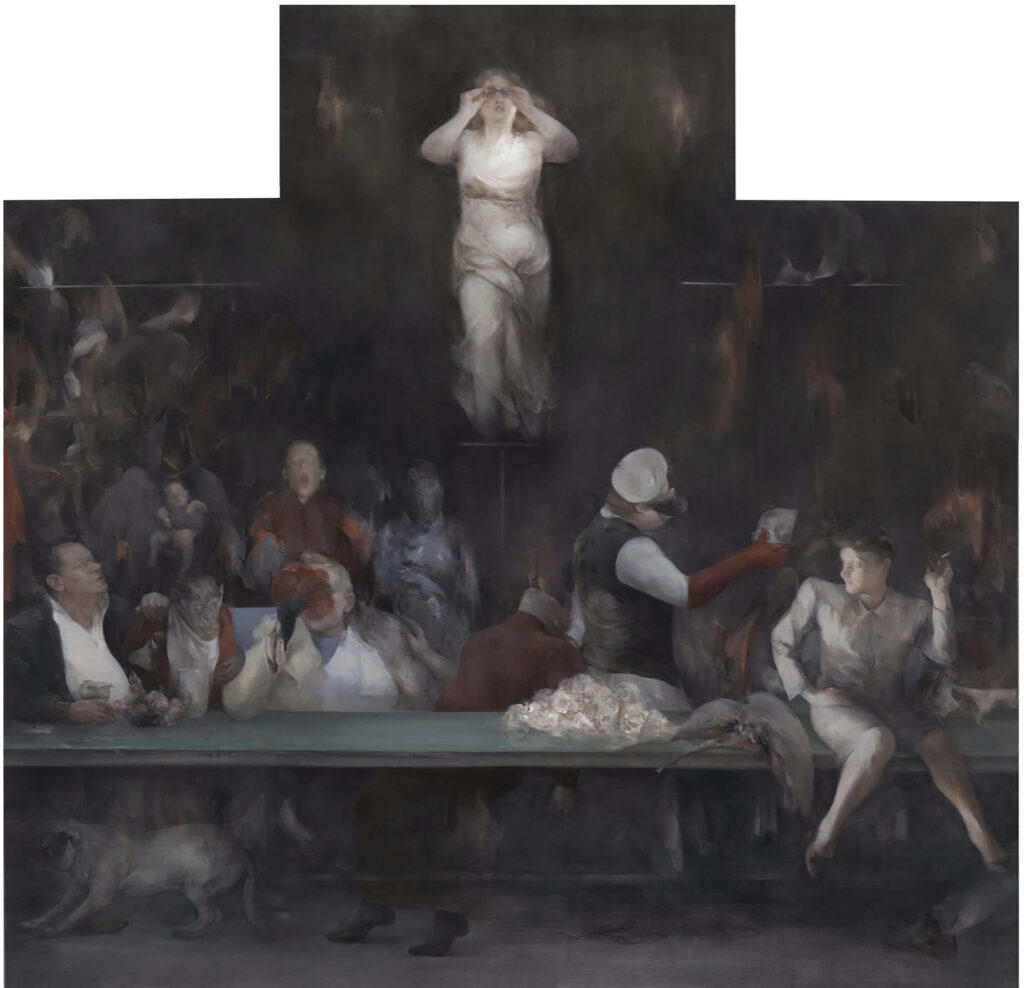
Her palimpsestic paintings hide as many concealed weapons, as many finely honed responses to the grip of the monstrous claw of existence.
Muted and elegant, this gray, thickened like the glue of a daily life where memories and feelings crystallize, bursts of powerful eroticism, desires fully confessed leaving their traces on panting canvases or in small precious frames like those cradling some old portrait.
Frescoes that subtly evoke the unleashing of a polished society where the obscenity of human passions is woven and displayed. Humiliated women, men decapitated by sharp irony, the crass stupidity of a supposedly elevated social class, surrendered, like the others, to the seven deadly sins.
Polyptych altarpieces representing the absurdity of our condition.
Hypocritical socialites. Disenchanted parties. The deceit of the human species, betrayal of friends, monkey-like faces of lovers. Insignificance of the so-called suitor. The pathetic dance of the virile lust.
Mists of a scattered and piercing childhood, incomprehensible discovery of a world that might be hostile, already brutal, perceived by a barely born child, a terrified child refusing to leave the nest nestled between her mother’s thighs.
This is, among other things, what Hu Shun Xiang confronts armed with her intelligence, great courage, slightly distant beauty, her obsidian gaze, her agile hands wielding the scalpel of brushes.
Her sensitivity as a standing woman.
Hu Shun Xiang is an important painter, her work grows as she reaches her full maturity.
She delivers a cruel beauty, the cruelty of the child disappointed by the world and abandoned by love. It is painfully true, like a sun filtered through the opacity of memories she dares to cover with gray while tracing on the canvas it sullies, the extraordinarily insightful perception of the living, of our impending loss, and the meanders of overly human desires.
Heddy MAALEM
精致——这是第一次见到她时最先浮现的词。
她看上去有些惶恐,不安于必须被拍摄的那种陌生感。
她之所以接受,大概是因为她富有胆识,也因为她的好奇,既是对自己,也是对那个她稍后将在影像中发现的自我。
第一次拍摄就呈现出一种惊人的效果。
她选择坐在摄影棚黑色毡布的地面上。脆弱地置身在恒定的光影之中,留下一个模糊的侧影让贪婪的镜头捕捉,她转身、闪避。
人们一开始或许以为她羞怯,但在最后,当她献出目光的那一瞬间,却显露出一名决绝的战士——她的双眼犹如深水的黑色谜团,承载着古老战争的伤痕。
它们凝视你,洞穿你,挑战你,让你不得不应战。
为了赢得她的友谊,例如,为了换取她肯给予你一点点自己。
那是一场精致的比试,一次以钝剑交锋的斗争。
在公众眼中,她是那位优雅、爱笑、友好而略带拘谨的年轻女子。
而在你面前,她给予的却是她眼中那颗黑色的钻石。
如同一位女斯芬克斯,她安静地等待你是否能作出回答——也许是无声的回答——去回应她深邃而神秘的美。
“What ?”——她似乎在问。
正如她那幅讽刺意味浓烈的画作的标题:一颗漂浮的大脑。
——是你的大脑吗?
要维系这种对话,首先需要倾听与关注。所有真正的友谊皆如此。
而首先,该去凝视胡顺香的艺术。
在凝视她的画作时,扑面而来的是一种浩瀚的感受:灰色底蕴的无处不在,以极端精致的笔触呈现出来。
画中既显出潜在的暴力、惊怕的回忆、讽刺与冷笑,也透出沉静的智慧、耐心的工夫、敏锐的直觉、悠长的记忆,和对消逝的恐惧、对欲望洪流冲击画布的恐慌。
又兼具毁灭性的幽默与细腻的优雅。从她童年泪水奔流的河道深处,流淌出这样极其复杂的灵魂。
区分。
爱。
力量。
慈悲。
有人会把胡顺香的艺术放入艺术史的脉络中。他们会看到其中有弗朗西斯·培根的痕迹,文艺复兴大师的影响,当然还有中华千年艺术的深厚底蕴,以及许多其他元素。但她的艺术已然超越、吸收并重新散发,化作一种独特、纤细的纯能量表达。
她的画布如同重写的古稿,隐约覆盖着无数暗藏的武器,以及对现实魔爪的精巧回应。
那抹灰色,既轻柔优雅,又厚重如同胶质,让回忆与情感困于其中,夹带着直白而强烈的欲望,留下痕迹在喘息不已的画布上,或镶嵌在小巧而珍贵的框景之内,如同古老肖像的遗照。
壁画般的构图,细腻地揭开一场“文明社会”的表象,那其中翻涌显露的是人类欲望的猥亵:
女人遭践踏,男人被讥讽斩首,某种“上层社会”的肮脏与愚昧,和他者一样,困于七宗罪。
多联祭坛画般的作品,将我们生存的荒谬诉诸画面。
虚伪的世俗应酬。
失去魅力的宴会。
人性的狡诈。
朋友的背叛。
恋人的猿猴般的面貌。
庸俗的伪追求者。
男性欲望的可怜舞蹈。
还有那弥漫的童年迷雾:幼时初见的世界残酷而陌生,使那未曾准备的孩子几近惊恐,迟迟不愿离开母亲双腿之间庇护性的温床。
这便是胡顺香所直面的:她的武器是智慧,是极大的勇气,是她疏离却动人的美,她那黑曜石般的目光,和操持画笔如同手术刀般敏捷的双手。
她以女性的敏感与坚强站立。
胡顺香是一位重要的画家,她的创作正伴随她走向成熟不断成长。
她揭示出残酷之美——那是世界让孩子失望、爱被遗弃的残酷。
它令人心碎,却真实无比,就像一轮被压抑的太阳,被记忆的阴翳所遮,却依然透过覆满灰烬的画布,以非凡的锐利目光,捕捉生命的本质、我们终将失去的存在,以及过于人性的欲望迷宫。
—— 赫迪·马拉姆
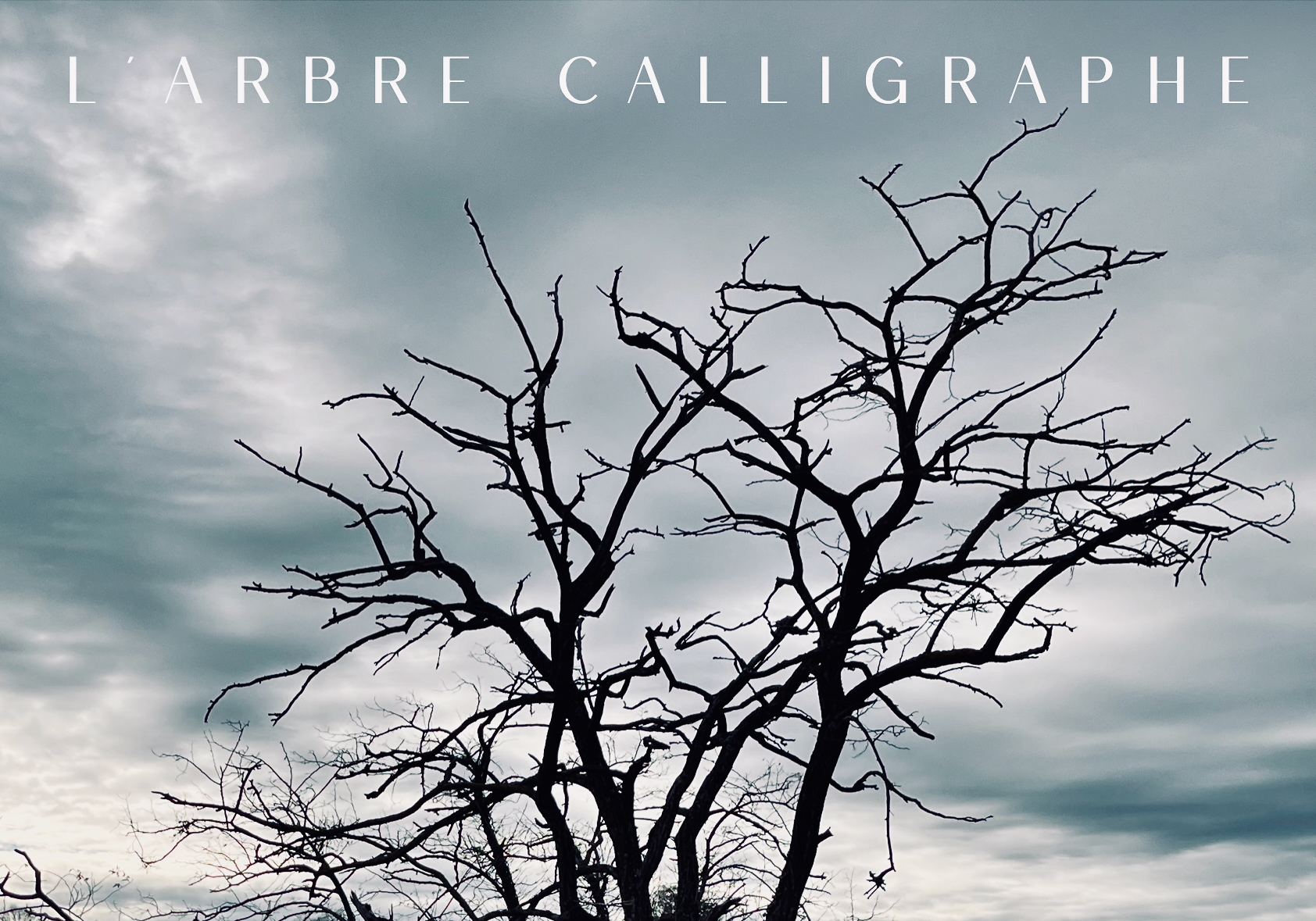
A few days ago, I was horseback riding with my son. As we took our usual route toward the hills, he pointed out a tree whose winter form revealed a remarkable pattern.
My son knows how to observe.
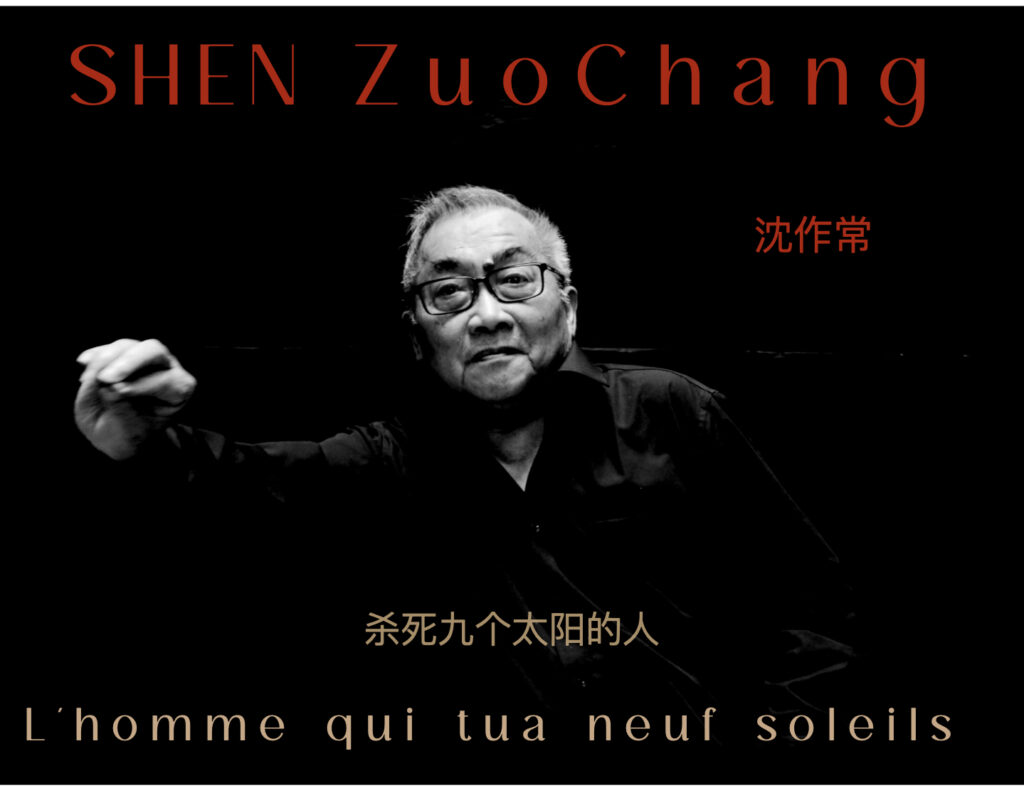
I hadn’t paid much attention to it until recently, when my friend Shen ZuoChang, from the beautiful and distant province of Sichuan, sent me some of his works—calligraphy, poems, and paintings, including a dozen specially created for me that touched my heart deeply.
I don’t know why, but a parallel formed in my mind between my calligrapher friend, whom I see energetically tracing his mysterious characters on the blank page, and that tree, standing alone at the road’s bend, pressing the outline of its shape against the sky’s page.
I returned by the same path without finding my tree. It was on the way back, as my horse eagerly rushed toward the stable, that I spotted it.
There are many trees in the hills of Ariège; stripped by the winter wind, they reveal their secrets previously hidden by the modesty of leaves.
Most are ordinary, some strive for a certain elegance, and very few are remarkable.
A bit like humans.
The tree I’m referring to, oddly isolated in this countryside landscape, is perhaps a kind of genius. It lines a small road where a few sad cars pass by, humming mindlessly.
I imagine few people notice it.
It’s the tree for a select few, perhaps just for one.
It simply exists and conveys its message to someone other than us.
Like Nietzsche, it chooses to look elsewhere, ignoring the triviality of our schemes, to say yes to the clouds.
It addresses the sky. It has patiently inscribed, by spreading its branches, the magnificent sign that came to it from the deep earth.
It has time.
The sky responds, and through its subtle color variations, nuances the sophisticated expression of energy that has risen up to it.
I watch it.
I see its branches sinking their black claws into the changing sky without remorse. I imagine a dialogue of the universe; from the night sky, a lightning bolt threatening to descend into the night where the tree fades away. And the response, patient, tenacious, elegant, filled with extraordinary complexity intertwined in the branches’ writing.
Or perhaps, conversely, the question posed and what, in echo, seems to laugh from the depths of our cosmic night.
The tree is there.
For nothing.
It gestures in vain, or almost, since despite everything, a solitary rider contemplates it, allowing himself to be moved by the power of its silent persistence.
I think again of my calligrapher friend, of his gesture when he routinely rinses the brush in the large porcelain bowl. The water gradually takes on the black hue of Chinese ink, just as, here, the liquid night darkens the sky and drowns the intricately carved branches.
It will soon cover everything with this shadow from which the coming day will emerge.
Dawn and daylight, eager assistants, will come to replace the darkened water of the night.
Soon there will be light, and the tree will repeat the same sign.
In vain, I tell myself, in vain.
One and two and three and four, say the hooves of my horse.
Come on, come on, move, move.
I know he is right, and I thank him as I sink into his rhythm of wisdom.
I now feel I understand a little better the simple and wonderful art of my friend Shen ZuoChang.
He behaves like the tree.
Heddy Maalem – January 2025
在两次仰卧起坐之间,春春发出了一种喉音,是蒙古的呼麦。我注意到,当他有点无聊或者因为排练拖得太久而不耐烦时,他就会这样唱。
我来到遥远的四川成都已经好几天了,一直在观看舞蹈家兼编舞家余尔格的排练,她是我多年的老朋友。
燕子和昀在走廊里抽烟。玥琦、嘉豪和韵寒是女生,立和邓,正在标记“聊斋志异”的一场戏,这是尔格最新创作,灵感来自17世纪中国作家蒲松龄的同名书籍。
这些“聊斋志异”中的五百多个故事,既充满了执着的幻想,也可以用这句话来概括:“世上不缺美
女!为什么非要娶个鬼?”
尔格的改编充满了幻想,技艺高超,敏感,聪明,有点疯狂而且非常动感。
看着我朋友的愿景日益清晰,我感到非常高兴。
她充满了能量和决心,一心向着她的目标前进。她知道自己要去哪里,并且像所有的创造者一样,在怀疑的森林中跋涉,拨开各种障碍的重重植被,直到发现从项目诞生起她直觉上知道必须到达的地方。
设计师超超,作曲家昕,剧作家洁,都默默地靠在工作室的墙边,帮助建构整个作品。
在成都这栋大楼的十六楼的排练室里,气氛轻松。
我观察着舞者们的动作,他们表面上似乎漫不经心,但实际上非常注意在需要他们的确切时刻出现。
他们的水平相当惊人,即使在中国,这也并不令人惊讶。
十多年前,我有幸在这里工作,认识并欣赏中国舞者。
我注意到他们取得了显著的进步。除了他们高超的技术水平,每个人都表现出极大的灵活性、成熟度和创造力。
最重要的是,他们的友善和谦虚。
我经常见到一些现代舞者,他们莫名其妙地觉得自己重要且优越,这种傲慢和自我感觉良好往往掩盖不了他们缺乏真正的才华。
与他们相比,在这里真是愉快得多,伴随着更好的公司。
作为优秀的专业人士,舞者们再次勾勒出他们动作的精准结构。
现在是90分钟完整排练的时刻。
尔格知道她需要删减和缩短,找出重复的部分,放弃它们,收紧她的叙述,使其在舞台上展现出集中能量的冲击力。
尽管我长期以来对这一过程已经习惯,但我仍然有些惊讶于当能量真正流动时,身体的变形。不再是虚假的表演。
在有些闷热的工作室里,每个人都毫不保留地拿出最佳表现。
多么强大的能量和变形!
工作人员围在尔格周围,提出批评和意见。用中文进行的讨论充满热情。
我利用自己对语言的完全无知,做我最喜欢的事情:观察和让我的心灵创造出自己的乐章。
捕捉此刻的诗意,理解事物的深刻意义,并借助他人的帮助,理解我自己生活的意义。
昀仔细地伸展,她的长辫子扫过地面。高大的舞者们往往对穿越她们的美视而不见。漂亮的玥琦以小步忙碌着,与露出耀眼笑容的嘉豪开玩笑,韵寒把那完美得有些不真实的面庞转向成都灰蒙蒙的天空,永恒的怀旧。燕子那张猫脸与春春开玩笑,后者把她拉入自己的仰卧起坐训练中,邓在角落里不声不响地伸展身体,同时向这些健身“苦力”投去有趣的目光。立在敲打他的电脑。我知道他对一切都充满好奇,尤其是现在的探戈,以及如何去找我的探戈朋友卡米洛,在卡利。
明天,我将开始与舞者们的拍摄。
我们彼此都很好奇。
明天会是个好日子。
我将为他们拍照。至少我会尝试,在大量的灰白光线下,从大窗户透过,俯瞰成都无限延伸的摩天大楼丛林。
我周围是二千万其他人,他们在完全漠不关心的情况下忙碌,而在这个工作室里,像世界上的许多地方一样,男女,大多数年轻人,感到有必要用身体来表达某些语言无法传达的人类状况。
我想到了法尤姆的肖像画,正面的美感,那种穿越世纪的“死者之眼”的生命冲动。
我的相机的数百万像素与蜂蜡、亚麻布、金箔和无花果木的力量相比,是多么微不足道!
但无论如何,我这样做,因为这是我的愿望和必要。
死者之眼对生者之眼,动作,舞动的能量,那些今天与我们对话的人。
他们明天会告诉我什么?会献上他们的真情实感吗?还是会给我最美的面具?
必须在场,抓住那真正的优雅时刻。
优雅,美丽和真理,将赐予我。
明天。
海蒂·马勒姆
成都,2024年6月
He turns his brush in the dark water of the ink stone. Focused. Like everything in a piece. An immense white sheet covers the entire length of the large workbench.
He begins. No hint of hesitation. The characters form at high speed without him retracing their paths. The ink of a deep black stains the sheet from top to bottom and from right to left. It goes quickly and it is very beautiful.
I observe the delicate yet firm contact of the brush tip with the paper.
He only interrupts to quickly dip the dried brush into the ink bath.
With his elbow at a right angle, his free hand firmly resting on the table wood, his whole body leaning over the work, he writes.
What could be more beautiful, I think.
Of course, the meaning escapes me. I have left the learning of Chinese and even more so, its characters, for another life.
But it doesn’t matter, I contemplate the beauty and meditate on the dance of the brush. There is no regret. Like in dance, something is written with no possibility of return. The body pierces the space, inscribing, or not, a gesture of speech. The calligrapher also traces in the untouched space of the paper, an irreversible statement.
Everything is in the manner, the style.
According to Master SHEN Zuo Chang, the essence lies in the contact between the fine tip of the ink and the whiteness where it lands. It is there, he says, that everything is at stake.
This persistent feeling of time slipping away comes to mind, which has inhabited me for a while. I watch the intricate sliding of the ink on the snow of the page. Time tumbles down like a drunken skier, I think, but in doing so, it inscribes, in the white of the slope, the irreparable enigma of each life.
What does he write, the one who traces the characters? Certainly, nothing trivial. I realize that ultimately that is not what matters. It is the act of writing that is significant and organizes the world by absorbing all the vital energy of this aged man, full of resolute strength and whose eye occasionally shines with a gentle irony.
I came to film him. He immediately understood and accepted my approach. It is obvious to him that dance and calligraphy (I almost wrote choreography) are linked. All arts, when reached at their peak, are.
It is that peak he has aimed for throughout his life and which this small, robust man, straightforward and curious about the fellow I am, has achieved.
Where would I like to shoot?
In a place where he feels good.
But right here, he says, spreading his arms, in this small shop located in the Song XianQiao district of Chengdu in Sichuan province.
Alas, not enough light!
So, in two days, in GuangHan where my museum is located, the BiLei Book House.
The place will be suitable.
Do you want to film like Picasso, through a glass?
He refers to “The Mystery of Picasso” by Henri Georges Clouzot.
Rather, in the void and without a brush if you agree.
He laughs.
Here I am at work. I have filmed the master at work and grasped a bit of his gesture.
His students, eager to do everything to help me and please the one they obviously admire greatly, stretch a large black canvas against the high wall of a patio ideally lit by a skylight.
I sense that the master is in a hurry. It will be one take and not two, I fear.
He is already in action, slightly to the side, bothered by the somewhat intrusive eye of the camera.
He is still as lively and precise; one can almost distinguish, in the void of the air, the elegant mark of his writing.
No embellishment, no pretense, just the necessary and accurate gesture.
That is how one should be when dancing, forgetful of oneself, solely concerned with tracing something worthwhile in space that the body can deliver. He draws from the animal within him, the intelligence of writing.
The gesture is beautiful, entirely offered, allowing the gaze to rest upon him without being diminished.
The light well will forever keep the secret of what, in a few minutes, was inscribed, drawn from the dark spiral of an energy of a man at the height of his art.
Later, he invites me upstairs where his works are displayed, paintings, watercolors, calligraphies whose quality and strength leave me somewhat astonished.
Master SHEN Zuo Chang is also a great painter.
It is clear he has studied the Moderns, and it is also evident that he draws abundantly from his own rich and ancient culture, which we Westerners barely grasp as we dabble in our « works in progress » and the murky waters of our art market.
SHEN, like the sages, remains discreet and continues his work without too much concern about being part of the game played within the void of ambition.
Towards the end of a long collection of paintings, some of which are pure dazzlement, I stop in front of the masterful representation of an archer aiming at the sun. On the left side of the canvas are depicted glowing discs. An extraordinary force of simplicity emanates from the almost abstract whole.
Perhaps beauty does invite insult, but before this painting, one politely steps back.
Master SHEN explains that the canvas portrays a scene from Chinese mythology. To save the kingdom, the renowned archer Houyi, at the request of King Yao, extinguished nine suns out of the ten that scorched the earth with their fiery power.
That is exactly what he does, I tell myself. He attacks this excess of sun that consumes the living. In the blinding whiteness of the page, he launches the arrow of his brush and draws from the night’s ink to make the unbearable light—which reveals the atrocity of our world—less intolerable.
Perhaps it is to better endure our lucidity that perceives the relentless sun of nonsense that we create, that we make ourselves, painters, writers, dancers, musicians…
There! I have my title: SHEN Zuo Chang, master in calligraphy, painter before the eternal …
The man who shot down nine suns.
Heddy MAALEM

中国之光
在两次仰卧起坐之间,春春发出了一种喉音,是蒙古的呼麦。我注意到,当他有点无聊或者因为排练拖得太久而不耐烦时,他就会这样唱。
我来到遥远的四川成都已经好几天了,一直在观看舞蹈家兼编舞家余爾格 排练,她是我多年的老朋友。
燕子和云在走廊里抽烟。悦琦、嘉豪和云汉,女生是李和邓,正在标记“聊斋志异”的一场戏,这是二哥最新创作,灵感来自17世纪中国作家蒲松龄的同名书籍。
这些“聊斋志异”中的五百多个故事,既充满了执着的幻想,也可以用这句话来概括:“世上不缺美女!为什么非要娶个鬼?”
二哥的改编充满了幻想,技艺高超,敏感,聪明,有点疯狂而且非常动感。
看着我朋友的愿景日益清晰,我感到非常高兴。
她充满了能量和决心,一心向着她的目标前进。她知道自己要去哪里,并且像所有的创造者一样,在怀疑的森林中跋涉,拨开各种障碍的重重植被,直到发现从项目诞生起她直觉上知道必须到达的地方。
设计师超超,作曲家星,剧作家洁,都默默地靠在工作室的墙边,帮助建构整个作品。
在成都这栋大楼的十六楼的排练室里,气氛轻松。
我观察着舞者们的动作,他们表面上似乎漫不经心,但实际上非常注意在需要他们的确切时刻出现。
他们的水平相当惊人,即使在中国,这也并不令人惊讶。
十多年前,我有幸在这里工作,认识并欣赏中国舞者。
我注意到他们取得了显著的进步。除了他们高超的技术水平,每个人都表现出极大的灵活性、成熟度和创造力。
最重要的是,他们的友善和谦虚。
我经常见到一些现代舞者,他们莫名其妙地觉得自己重要且优越,这种傲慢和自我感觉良好往往掩盖不了他们缺乏真正的才华。
与他们相比,在这里真是愉快得多,伴随着更好的公司。
作为优秀的专业人士,舞者们再次勾勒出他们动作的精准结构。
现在是90分钟完整排练的时刻。
二哥知道她需要删减和缩短,找出重复的部分,放弃它们,收紧她的叙述,使其在舞台上展现出集中能量的冲击力。
尽管我长期以来对这一过程已经习惯,但我仍然有些惊讶于当能量真正流动时,身体的变形。
不再是虚假的表演。
在有些闷热的工作室里,每个人都毫不保留地拿出最佳表现。
多么强大的能量和变形!
工作人员围在二哥周围,提出批评和意见。用中文进行的讨论充满热情。
我利用自己对语言的完全无知,做我最喜欢的事情:观察和让我的心灵创造出自己的乐章。
捕捉此刻的诗意,理解事物的深刻意义,并借助他人的帮助,理解我自己生活的意义。
云仔细地伸展,她的长辫子扫过地面。高大的舞者们往往对穿越她们的美视而不见。漂亮的悦琦以小步忙碌着,与露出耀眼笑容的嘉豪开玩笑,云汉把那完美得有些不真实的面庞转向成都灰蒙蒙的天空,永恒的怀旧。燕子那张猫脸与春春开玩笑,后者把她拉入自己的仰卧起坐训练中,邓在角落里不声不响地伸展身体,同时向这些健身“苦力”投去有趣的目光。李在敲打他的电脑。我知道他对一切都充满好奇,尤其是现在的探戈,以及如何去找我的探戈朋友卡米洛,在卡利。
明天,我将开始与舞者们的拍摄。
我们彼此都很好奇。
明天会是个好日子。
我将为他们拍照。至少我会尝试,在大量的灰白光线下,从大窗户透过,俯瞰成都无限延伸的摩天大楼丛林。
我周围是二千万其他人,他们在完全漠不关心的情况下忙碌,而在这个工作室里,像世界上的许多地方一样,男女,大多数年轻人,感到有必要用身体来表达某些语言无法传达的人类状况。
我想到了法尤姆的肖像画,正面的美感,那种穿越世纪的“死者之眼”的生命冲动。
我的相机的数百万像素与蜂蜡、亚麻布、金箔和无花果木的力量相比,是多么微不足道!
但无论如何,我这样做,因为这是我的愿望和必要。
死者之眼对生者之眼,动作,舞动的能量,那些今天与我们对话的人。
他们明天会告诉我什么?会献上他们的真情实感吗?还是会给我最美的面具?
必须在场,抓住那真正的优雅时刻。
优雅,美丽和真理,将赐予我。
明天。
赫迪·马勒姆
成都,2024年6月
LIGHTS OF CHINA
Between two sets of crunches, Chun Chun lets out a throat
song, the Mongolian Khoomii. I noticed he sang like this
when he was a bit bored or impatient because the
rehearsal dragged on.
It has been several days now, since my arrival in
Chengdu in faraway Sichuan, that I have been attending rehearsals
of the company of Er Ge YU, a renowned dancer and
choreographer, a long-time friend.
Yanzi and Yùn are in the hallway. They smoke their cigarette.
YueQi, JiaHao, and YunHan for the girls; Li and Deng for the
boys mark one of the scenes from “Strange Stories in a Chinese
Studio,” the latest creation by Er Ge inspired by the eponymous
book by PU Song Ling, a Chinese writer from the 17th century.
These “Chronicles of the Strange,” rich with about 500 tales
that are as obsessive as they are fantastical, could be summed up by
this quote: “There is no shortage of pretty girls in this world! What
a silly idea to want to marry a ghost!”
The adaptation made by Er Ge is whimsical, virtuosic, sensitive,
intelligent, a bit crazy, and very dynamic.
I enjoy seeing my friend’s vision crystallize over the days.
She is, with energy and determination, fully focused on her goal.
She knows where she is headed and, like any creator, navigates through the forest
of doubt, clearing the thick vegetation of obstacles of all
sorts, until she discovers that place where, since the inception of
her project, she intuitively knows she must go.
Chao Chao the designer, Xing the composer, Jie the playwright,
each huddled against a wall of the studio, work
silently to help build the ensemble. The atmosphere is relaxed on the sixteenth floor of this building in
Chengdu where the rehearsal studio is located.
I observe the maneuvers of the dancers and how, beneath a
seeming nonchalance, they are attentive to being present at the
exact moment they are needed.
Their level is quite extraordinary even if in China, it’s not
surprising.
I myself, over a decade ago, had the chance to
work here and to know and appreciate Chinese dancers.
I note the remarkable progress that has been made. In addition to
their high technical level, the availability, maturity, and
creativity of each one.
Above all, and what matters most to me, their kindness and
humility.
I have often witnessed the somewhat disdainful arrogance of
certain contemporary dancers who, for some strange
reason, seem completely absorbed by their importance and by
their supposed superiority. It is unbearable arrogance and
most of the time reflects a tragic lack of real talent that
cannot be masked by a facade of confidence bolstered by a
supercilious exclusiveness.
How wonderful it is to be elsewhere and in better company.
As good professionals, the dancers outline for the umpteenth
time the precise architecture of their movements.
It’s the moment of the 90’ run-through.
Er Ge knows she will need to trim and shorten, identify the redundancies,
give them up, contract her message so that it delivers, on stage,
the impact of her gathered energy.
I watch, still somewhat dumbfounded despite my long experience, as
the bodies metamorphose when the energy truly flows.
There is no more pretense.
In the somewhat stifling heat of the studio, everyone gives
the best of themselves without holding back.
What energy and what transformation! The staff rushes around Er Ge to offer their critiques and
share their impressions. The discussion in Chinese is passionate.
I take advantage of my total ignorance of the language to do what
I love most, observe and let my mind create the chant that
will come to it.
Capturing the poetry of the moment, understanding the deeper meaning of
things and, with a bit of luck, thanks to others, the meaning of my
own life.
Yùn stretches diligently, her long braid sweeps the floor. The
tall dancers are often oblivious to the beauty that flows through them. The lovely YueQi busies herself with little steps, joking with
JiaHao with his dazzling smile, YunHan turns a face of
somewhat unreal perfection towards the nostalgia of the
perpetually gray sky of Chengdu. Yanzi, with her cat-like face,
jokes with Chun Chun who has recruited her for his
crunch sessions, Deng discreetly stretches in his corner while
casting amused glances at the fitness junkies. Li taps
on his computer. I know he is curious about everything and especially, at the
moment, about Tango and how he might join my
tanguero friend, Camilo, in Cali.
Tomorrow, I will start filming with the dancers.
We are curious about each other.
Tomorrow will be a good day.
I will try to capture their portrait. At least I will try, in the abundant
and somewhat gray light of the large bay window that opens
onto the endless monstrosity of Chengdu’s skyscrapers.
I am surrounded by twenty million others who wander in
absolute indifference to what is happening in this studio where, like
everywhere else in the world, women and men, mostly young,
feel the need to express with their bodies something of their human condition that words fail to
speak.
I think of the Fayum portraits, their frontal beauty, the
“gaze of the dead” whose life pulse reaches us through
the centuries.
As the millions of pixels from my camera weigh little compared
to the intact force of encaustic and linen, of gold leaf and
beeswax, of sycamore wood!
What does it matter? I take the action because it is my desire and my
necessity.
Gaze of the dead for the gaze of the living, gestures, movements,
energy of those who dance and speak to us, today.
What will they tell me tomorrow? Will they offer the gift of their intimate truth?
Or will they give me the lie of their most beautiful mask?
I’ll need to be there and embrace it all, catch on the fly the true grace of
the moment.
Grace, beauty, and truth that will be granted to me.
Tomorrow.
Heddy MAALEM
Chengdu, June 2024

舞者没有什么是容易的。
例如,试镜常常是一场令人心碎的争斗。
然而,有一个明显的事实似乎每个人都忽视了:雇佣雇佣兵就像在自己家中引入战争。
没有信念地投身其中无疑会杀死那些你声称要为之而活的东西。
理想的情况是,在可能的情况下,让亲和力发挥作用。
跳舞不是每个人都能做到的。
任何声称要跳舞的人至少要了解自己的身体,并努力理解其结构。
但最重要的是,最好是像美国人所说的那样,“天生的”。
一种天赋,一种存在感。
天生的。
即使有些人说相反的话,我一直观察到一些人出现时,其他人却在努力存在,大多数人根本不在自己的位置上。
我记得在巴塞罗那的莱亚。
她迟到了,跑着去赶上已经在工作的小组。加州冲浪者的步伐,同样阳光下的显而易见。
还有索莱,在荷兰的光线中,像一团野火和苍白的火焰,孤独地存在,
即使四十个舞者的喧嚣也无法掩盖她那种强烈、凶猛而神秘的自我存在。
然后是尔歌,最后。
我在中国。我记得。
我们离我版《春之祭》的中国首演还有一周时间。
四川舞团的一位领导,那个抽烟太多,用沙哑声音说话的人:
你必须看一个女孩,她很厉害。
一手拿着香烟,一手拿着电话,尽管我拒绝在这么短的时间内加入新成员,他还是坚持。
我最终还是屈服了。
我们在剧院排练。
一个充满能量和优雅的小个子女孩轻快地跳上了舞台。
在一个瓷器般的身体中,像老虎般的跳跃,既圆润、优雅又强壮,既低调又具有非凡的运动能力。
真是个出现!
多年过去了。尔歌一直为我跳舞,始终才华横溢,谦逊,友善和非常专业。
她在欧洲和亚洲都有着成功的职业生涯。
如今,她已经成熟,具有一种严肃而深沉的美。
描述她的舞蹈对我来说是不可能的。
那是一种穿透你并让你惊讶的感觉。
一个耐心的小个子女孩保留地站在你面前。
舞蹈抓住了她,那是一场美的爆发。我的意思是,这种矛盾的扭曲在于你所看到的和应该是的之间,每一秒都在变化,几乎不是人类的活力。而且它既慢又快,紧张,内敛,给予,放弃,释放和呈现,但仍然保守秘密,埋藏在自己体内,像一个宝藏,一道光,一个古老的天朝帝国的珠宝。
需要多少努力,决心,勇气和深刻的直觉,年复一年,在近视的观众和极端的评论家面前,找到力量奋斗,让自己体现出如此古老文化的丰富,我们的文化相比之下几乎刚刚诞生。
尔歌在中文中的意思是公主,还有其他我忘记的意思。
她的父母为她取了一个好名字,让她继承了一长串在用身体思考和表达艺术方面的女性和男性的传统。
这位舞者像是石洲的书法,他是森林画笔的大师。圆润又棱角分明,狂草般地不可思议的高超技巧。
她也是墨,那在她胸腔中旋转的烟黑色。她的心就像一块墨石,碾磨木材来书写每一个真实的动作。
今天,有一颗星星在那边闪耀,但我们看不见,我们不再仰望天空,不再知道曾经连接大地和天穹的事物,我们接受了没有美的生活。
我记得柯克·道格拉斯在扮演那个和他的马威士忌一样野性的牛仔时说的台词:“我无法想象世界会变得更好。像你一样,我看到它在变得更糟。我看到自由像一条狗一样被扼杀,无论我目光所及之处。我看到我自己的国家被丑陋所淹没,…”
一部好电影,一部杰作。它让我想起了这位骑手和他的金色马匹的画面,像是一种美丽被威胁的力量,冲破了禁止古老荒野的铁丝网。
尔歌让我想起了贯穿整部电影的那种美丽的力量。人类在试图逃离这个世界压迫性的叙述。
这位舞者是一位孤独的战士,低调而温柔,毫不犹豫地射出她美丽的箭矢。
她永远不会放弃她那高贵且必要的孤独,但如果你遇见她,她的舞蹈会穿透你。
赫迪·马勒姆
Nothing is easy for dancers.
Auditions, for instance, are often a disappointing struggle.
Yet there is this obvious truth that seems to escape everyone: hiring mercenaries brings war into one’s own home.
Engaging without conviction surely kills what one claimed to live for.
The ideal, when possible, is to let affinities play out.
Dancing is not for everyone.
The least one can do if they claim to dance is know their body, having made the effort to understand its structure.
But above all, it’s better to be what Americans call “a natural.”
A talent. A presence, too.
Innate.
Even if some argue otherwise, I have always observed that some stand out when others struggle to exist, with most simply not being in the right place.
I remember Laïa in Barcelona.
She was late and was rushing to join the group already working. The stride of a California surfer, the essence of the same sun.
And Soile, a wild and pale flame in the light of Holland, alone,
even as the hustle of forty dancers fails to overshadow this intense,
fierce and mysterious presence of herself.
And then there’s Er Ge.
I was in China. I remember.
We were a week away from the premiere of the Chinese version of my Rite of Spring.
One of the directors of the Sichuan company, the one who smoked too much and spoke in a rough voice:
You need to see a girl; she’s very strong.
Cigarettes in one hand, phone in the other, he insisted despite my refusal to bring in a new element with such little time.
I eventually caved.
We were rehearsing at the theater.
A small ball of energy and grace bounced lightly onto the stage.
A tiger’s leap in a porcelain body, round, graceful, and powerful all at once, discreet yet with extraordinary athletic radiance.
What an appearance!
Years passed. Er Ge YU has danced for me, always with talent, humility, kindness, and great professionalism.
She is having a successful career in Europe and Asia.
She is now accomplished, mature, with a grave and profound beauty.
Describing how she dances seems impossible.
It’s a sensation that passes through you and surprises.
A petite young woman with a patient body stands before you with restraint.
Dance takes her, and it’s an explosion of beauty. I mean, this contradictory twist between what you see and what should be and yet isn’t, changing each second with an almost superhuman vivacity. And it’s slow, yet fast, held, contained, and then given, abandoned, released, delivered, and yet kept secret, buried within, like a treasure, a light, an ancient jewel of the Celestial Empire.
It takes a lot of work, determination, courage, and deep intuition, year after year, in front of myopic audiences and polarized critics, to find the strength to fight and manifest all the richness of such an ancient culture that ours, in comparison, seems hardly born.
ER Ge in Chinese means Princess and other things I’ve forgotten.
Her parents named her well, making her the heir of a long dynasty of women and men who became masters in the art of thinking with and through the body.
This dancer resembles the writing of Shi Zhou, great calligrapher and master of the Forest of Brushes. Curved and angular, wildly cursive, incredibly virtuosic.
She is the ink too, that black smoke swirling in her chest. Her heart is like an ink stone grinding the necessary black wood for writing every authentic gesture.
Today, a star shines over there but we cannot see it, we who no longer look at the sky, who have no idea what once connected the earth to the firmament, we who accept to live in the absence of beauty.
I remember Kirk Douglas’s monologue when he played that cowboy as wild as his mare Whisky: “I can’t imagine the world getting better. Like you, I see it rather getting worse. I see freedom being strangled like a dog, everywhere my gaze falls. I see my own country collapsing under ugliness…”
A beautiful film, a masterpiece. It comes to mind because I remember this rider united with his golden horse as an image of a threatened beauty forcing the barbed wires forbidding the ancient wild plains.
Er Ge reminds me of that magnificent momentum that sweeps through the entire film. The struggle of humanity trying to escape the overwhelming discourse of the world.
This dancer is a solitary warrior, discreet and gentle, shooting without trembling the vibrant arrows of her beauty.
She will never abandon her high and necessary solitude, but if you cross paths with her, her dance will pierce you.
HEDDY MAALEM
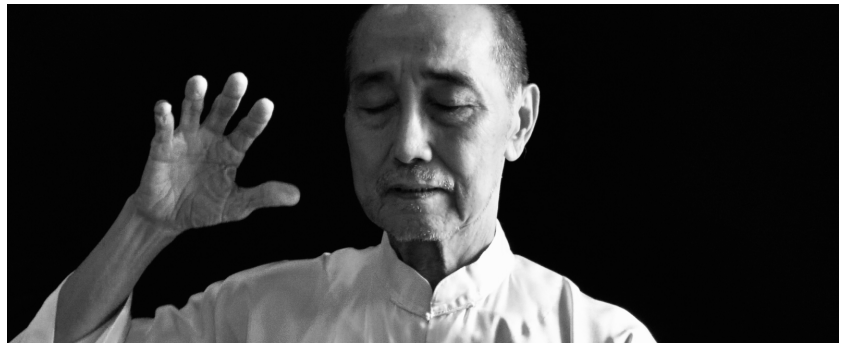
在马来西亚八打灵再也的一个公园里,我遇到了李唐国大师。
他正在观察他的一些学生练习“推手”,这是太极拳的一种练习,学员们互相推搡,试图占据优势。
没有技巧,李大师说,只需要练习,这样才能学会。
在这个早晨,太阳准备把美丽的吉隆坡的巨大心脏烤熟,天气已经开始变得非常热。
公园很舒服。很少有散步的人。在城市不停的喧嚣中有一点安宁。
李大师谈话很多且自由。他不扮演萨满的角色。
只有他的眼睛沉默并注视着你。
他看起来比实际更高。这是因为他瘦削。他高挑且平静。外表脆弱但内心强大。
这正是我们应该的样子。
我们应该无所畏惧地从自己身上冲出去,毫不畏惧地将我们的脆弱与世界的坚硬对抗。
李大师没有神秘感,他不做作,他走来走去,笑得很多,给他的学生们提供好的建议,他们出汗并且也因他们的努力而笑,在不久将成为一个蒸汽室的地方。
我从远处观察这种练习的谦逊。我看到,在距离我命运所在地方几千公里的地方,有人们试图通过练习战斗的艺术来理解自己的黑暗。
我曾经长时间做同样的事情。
我把手放进了阴影的口中。
我感受到了里面旋转的能量。
首先是恐惧,李大师对我说。这是我们必须战胜的。这是我们必须理解的。实践才能真正做到这一点。
这个人很友善和善良。
我感觉他通过我对他来说的奇怪陌生人,感知到了一个聆听的人,他也以自己的方式,利用与他人的斗争来避免自我毁灭。
我想拍摄你的动作的本质,我对李大师说。
拍什么?我的太极没有形态。
那么,让我们拍摄无形的东西。我会尽力而为。
为什么不呢?
学生们推搡出汗,战斗和躲避,体验和失败。
对方仍然不妥协。这是一扇紧闭的门。没有钥匙。锁臂技不管用。蛮力在头内外制造了一堵墙。
对方当然是钥匙,但如何打开呢?
他来了。
我们在拉姆利哈桑工作室,位于布城高地,工作室的主人Sabera优雅而坚定地管理着它。
他穿着一套简单而丝滑的太极服。他像往常一样平静,并对摄像机的存在感到有些不安。
这个人不喜欢被注视,也不喜欢被困在任何该死的盒子里。
他出于同情并可能因为某种好奇心同意了,看我将如何摆脱可能很快变成的困境。
我拍摄他,首先站在大窗户的斜光中,从那里可以看到被恶魔般的污染形成的雾气遮蔽的宏伟清真寺。
他勾画出一些动作。我只看到他瘦长的剪影,仿佛出自某个热带的贾科梅蒂之手。
他似乎有点心不在焉,不知道该给摄像机那只独眼和贪婪的眼睛什么。
他所激发的东西不再可见。一切都发生在一个已经走到成为道路的人的内心。
他的身体轻盈而庄重,是一个疑问。没有其他东西是可以察觉的。
我发现自己在拍摄这个问题。
我习惯了。
他是否感到无助?仿佛失去了自己的存在感,他的身体在空间中优雅地勾勒出一种形式的本质。他既精确又模糊。有点走神,但却毫不费力地吸引了对方的注意。
我提议他坐下。
为了做什么?他问。
同样的事情。
你是个优秀的斗士,他半笑着对我说。
我在拍摄。
我看不到任何东西。我只感受到观众沉默的敬意。
在这个坐在椅子上的庄重的男人的微小动作中,发生了一些重要的事情。
我们结束了。他站起来,显然松了一口气。我觉得这一切都不适合他,我几乎为把他置于这种不适合他的境地感到后悔。
他却微笑了。
问题总是恐惧,他对我说。
我有点愣住了。他似乎在重述我们最近在公园的对话。
被拍摄对他来说是一个无关紧要的事件。
不能有防备。采取防备姿态,已经表现出恐惧。必须安静地保持在自己的轴线上,观察对手在自己的愤怒中筋疲力尽。
我同意。他是对的。最终我们理解了战斗的唯一意义在于必要的放弃,同时保持在对抗中建立的竖直。
但为什么他如此坚持这一点?
他礼貌地离开了。我有些困惑。我预感错过了一些东西。
我理性化。大师可能累了。我不应该坚持拍摄他。
那天晚上,当我观看这些画面时,我明白了。
在我找到一首我认为能够揭示手势简单性所隐藏的东西的音乐的同时,我领悟到我在忙于抓住某种难以言喻的东西时得到了的教训。
一个人不断地对我讲话,虽然我忙于拍摄但没有停下来听他。
他在向我展示那未完成的东西,那我们无法达到但却仍在手势中存在的东西,那简约的形式,那纯粹的东西,那我们有时用一生追求的东西。
他展示了一个完整的人,仅仅是他自己,太极大师和一个美丽的花朵盛开的动作园丁,每一个动作如同不断在颤抖的手中绽放的简单花朵。
是的,必须战胜恐惧,面对死亡时,必须站直,毫无防备地唱出我们的动作之歌。
没有之前,没有最初的意图。只有去和想要的东西。
必须现在,在“开放”中活着。
还必须看见,听见,聆听。不被自己的忙碌所欺骗。
我写信感谢李大师的帮助。他祝我好运,并发来了一段庄子的文字,这位流浪的大师以他的神游著称。
它讲述了一个人在湖中心的船上的故事。题目是,《空船》。
这就是所谓的真人,一艘在道的广袤空虚中的空船。
我想起李大师和他无形的太极。
那些不幸想要与他对抗的人自讨苦吃。
他们让我奇怪地想起那些走进遥远西部酒吧的顾客。门扇为让他们通过而摆动,它不抵抗,而是平静地在铰链上转动。每个人走进酒吧,找到他们所寻找的东西。有些人忘记了,另一些人,漂亮酒吧女郎的虚幻陪伴,许多人,带来的暴力,还有一些,他们无法淹没的悲伤。很少有人有足够的智慧去遇见那些凭一点运气和洞察力可能找到的东西:信仰,爱,希望,甚至,友谊。
李唐国,八打灵再也的普通居民,太极拳大师和庄子的智慧读者,通过柔顺地面对我直接的要求,使我的船轻了一些,也让我明白,要到湖上去然后穿越世界的大河,
首先需要升起自己的帆,然后,敢于将它交给风。
赫迪·马勒姆 – 吉隆坡,2023年6月
It was in a park in Petaling Jaya, Malaysia, that I met Master Tangkok Lee.
He was watching some of his students practicing « pushing hands, » an exercise from Taijiquan where pairs push against each other, trying to gain an advantage.
There is no technique, Master Lee says; you must practice, and that’s how you learn.
It’s already getting quite hot that morning as the sun prepares to bake the vast heart of beautiful Kuala Lumpur.
The park is pleasant. A few rare strollers. A bit of tranquility amidst the city’s relentless hustle.
Master Lee speaks openly and at length. He does not play the shaman.
Only his eyes are silent, and they see you.
He seems taller than he actually is. This is due to his thinness. He is slender and calm. Fragile in appearance but strong within.
This is how we should be.
We should leap outside of ourselves, unafraid to contrast our fragility against the world’s harshness.
Master Lee makes no mystery of his teachings; he does not pose, he walks, laughs a lot, and gives great advice to his sweating students who also laugh at their efforts in what will soon become a sauna.
I watch from afar the modesty of this practice. I see, thousands of miles from where destiny has placed me, men trying to understand their own darkness by practicing the art of combat.
I have long done the same thing.
I have reached into the mouth of shadow.
I have felt the energy swirling within.
It is fear at first, Master Lee tells me. That is what you must combat. That is what you must understand. Practice enables you to do this.
This man is friendly and benevolent.
I sense he perceives, through the strange foreigner I am to him, someone who listens and who has, in his own way, also used combat with others to avoid his own destruction.
I would like to capture the essence of your movement, I say to Master Lee.
What to capture? My Taijiquan has no form.
Then let’s film what is formless. I will do my best.
Why not?
The students push and sweat, struggle and dodge, experience and fail.
The other remains unyielding. It’s a closed door. We do not have the key. Arm locks won’t work. Raw strength builds a wall, both inside and outside the head.
The other is the key, of course, but how do we unlock it?
He has come.
We are at the Ramli Hassan studio, high up in Bukit Tunku, which is run with elegance and firmness by its owner, Sabera.
He wears a simple and silky Taijiquan outfit. As usual, he is calm but a bit uncomfortable with the camera’s presence.
This man does not like to be watched or trapped in any damned box.
He consents out of empathy and perhaps a certain curiosity about how I will manage what could quickly become a misstep.
I film him, first standing in the slanting light of the large window where the grand mosque can be seen through the foliage and the fog created by the demonic pollution.
He sketches a few movements. I can only see his elongated silhouette as if it sprang from the hands of some tropical Giacometti.
He seems a bit absent, unsure of what to offer to the camera’s blind, greedy gaze.
What he puts in motion is no longer tangible. Everything happens inside
a man who has walked the path to become the way itself.
His light and serious body is a question. Nothing else is perceptible.
I find myself filming the question.
I am used to it.
Is he disoriented? As if deprived of his own presence, his body gracefully traces in space the essence of a form. It is precise and vague at the same time. A bit elsewhere, it nevertheless demands the presence of the other effortlessly.
I suggest he sits.
For what purpose, he asks.
The same thing.
You are an excellent fighter, he tells me with half a smile.
I film.
I see nothing. I only feel the quiet silence of the few people watching the shoot.
Something important happens in the almost nothing of this dignified man’s gestures, sitting upright in the chair.
We finish. He rises, visibly relieved. I sense that this was not for him, and I almost feel guilty for putting him in a situation that does not suit him.
He smiles nonetheless.
The problem is always fear, he tells me.
I am a bit taken aback. He seems to recall our recent conversation in the park.
Being filmed was a non-event for him.
You must not guard against anything. To be on guard already shows fear. One must calmly remain on one’s axis and observe the opponent exhaust themselves in their own rage.
I agree. He is right. We ultimately understand that there is no other meaning to combat than that of its necessary surrender while retaining the vertical built in adversity.
But why does he insist so much on this point?
He politely departs. I remain a bit perplexed. I have a feeling I am missing something important.
I rationalize. The master is probably tired. I should not have insisted on filming him.
That evening, while reviewing the footage, I understand.
As I find the music that, in my opinion, reveals what the simplicity of the gestures conceals, I perceive the lesson that was given to me while I busied myself trying to grasp the ineffable.
A man was addressing me insistently and had not ceased to do so. He saw me and signaled me.
Hidden behind my camera, I was not listening.
Yet, he was showing me the unfinished thing, that which one does not achieve but the gesture that remains, to the stripped form, to the essence, that which one aspires to and sometimes dedicates one’s life to.
He was showing me a whole man and only him, master and gardener of a splendid blossoming of gestures like simple flowers constantly blooming in quivering hands.
Yes, it is fear we must combat, and before death, we must stand tall, unguarded, and sing our song of gestures.
There is no before, there is no initial intention. There is something that moves and desires.
We must be alive, right now, in the Open.
We must also see and hear, listen. Not be fooled by our busyness.
I wrote to Master Lee to thank him for his availability. Wishing me good luck, he sent me a text from Chuang Tzu, the wandering master of ecstatic journeys.
It speaks of a man on a boat in the middle of a lake. The title is “The Empty Boat.”
This is how the true man is, an empty boat in the vast emptiness of the Tao.
I think back to Master Lee and his formless Taijiquan.
Those who take the unfortunate idea of opposing him will surely be disappointed.
They strangely remind me of those clients pushing the door of a saloon in a distant Wild West. The door swings to let them through, offering no resistance but pivoting quietly on its hinges. Each enters the bar and finds what they came for. Some forget it, others seek the illusory companionship of the pretty barmaid, many bring the violence they carry within, and others still, their sadness that is impossible to drown. Few possess enough wisdom to encounter what is still possible to find with a bit of luck and discernment: faith, love,
hope, and even friendship.
By smoothly pivoting in response to my frontal request, Tangkok Lee, a simple resident of Petaling Jaya, master of Taijiquan and wise reader of the great Chuang Tzu, allowed me to lighten my boat a little, but also to understand that, to sail on the lake and then cross the great river of the world,
one must first set one’s own sail and then dare to hand it to the wind.
Heddy Maalem – Kuala Lumpur, June 2023

他的舞蹈超越了一切束缚。人们试图将其归类,锁在狭小的惯常之中,以便不再讨论它。然而,我们应该反其道而行之,并坚定地说:
这位舞者是一位大师。他掌控自己,掌控自己的每一个动作,如同箱外的天使或恶魔,无法被束缚。毫无疑问,他是充满灵性的。他的动作是在对时间的恰当延展中实现的,捕捉到理解之后的感知,节奏和空间,以及我们目光的随机性,和我们几乎无法真正集中注意力的缺陷。
他无视主流的风向,只在意那些重要的事物:黑暗、时空、能量——这些源自我们内心的力量,被他的动作带到明处。我们必须钦佩这样一个人,他远离当代的混乱,进行真正的战斗,不断地为美而战。
在寂静中,他的舞蹈化作音乐。他在平静中移动,孕育出“事物的旋律”。这是一种稀有的景象!
我想到了我们当下的荒谬,那些无谓的扭动,这些苍白却又聚集支持的动作。这种急于展示的喧闹,显然,几乎没有什么可展示的。他远离这种争夺。他专注于身心的修炼,他柔软、伸展、清洗和呼吸,最重要的是,他倾听内心涌向表面的脉动,那些他辨识、运用、理解并升华的杂乱无章的冲动。
他精确而清晰,他的一切,都是对当下的敏锐意识,对有机运动的尊重,通过身体理解智慧的来源。在他身上,舞蹈动作和日常行为之间的界限是模糊的,仿佛只需稍微调整焦距,舞蹈便会立刻显现,并奢华地展开。
或许,谈论舞蹈是徒劳的,但我们必须自由地表达我们所感知到的珍贵与罕见,以便可能触及那些已然消失的东西。看着这个人,我越来越觉得,他体现了每个舞者应追求的目标——舞动的自然显现,身体作为艺术品的存在。
这不是自恋,只是一个奉行自律、深刻理解肢体运动、甚至高超技巧与舞蹈区别的人。舞蹈不仅是一种思想,更是一种运动的诗学。
成为白纸和那划线的手,成为光明与黑暗,成为在永恒当下的敏感动物,成为冥想来自深渊黑暗的灵魂。消失以体现存在,先于语言却有所表达。
“这是世界之夜向每个人走来。”黑格尔如是写道。这句话在看他舞蹈时浮现于脑海。他的动作如同投下的阴影。他源自日本的“黑暗之舞”——舞踏。他舍弃了舞踏的过度,保留了其深度,意识到一个充满剧痛的世界,并渴望将其具象化。
他舞动我们内心行走的夜晚。他的双脚在他决定停下的地方完美地停住。他的眼睛平静地注视着前来欣赏他表演的观众。他的目光是第一个动作,空间打开,表演可以开始了。
事实上,我们在那里,观察彼此,在光影之间聚集。黑暗降临,召唤着寂静,接着光明回归,我们默默无言,在阴影中窥探,像迷惑的森林动物。我们对自己依然是个谜,需要不断地呈现,以感知其轮廓。
表演结束。黑幕再次降下,直至我们的语言和白昼的谎言中重现的喧嚣。舞蹈发生在两夜之间。我们留下了印记。
他展开他的动作,突然停下。那条线穿过他,如同画家在画布上那霸气的笔触。一个无悔的动作。这让我们无言。无尽的喧哗终于停止。我们在谜团前无言以对,终于在狮身人面像前静止,这块或许曾经移动的动物石。
他身上有种矿物质的感觉。让我想起曾经的一位合气道大师。我曾看他从道场入口走来,柔软地跪下,突然完全静止,成为一块石头,面对我们,面对我们对身体和它所含深渊的无知。这是我的第一课。不动存在,而石头可以说话。
的确,看到一个人舞蹈是罕见的。大多数时候,总有些不对劲。我们无法确切说出是什么。仿佛是一种模拟,一种或多或少复杂的肢体动作,忽略了语言的必要性。“一场毫无意义的舞蹈。”借用查布里耶的话。于是我们转向自然,那从舞蹈所寻之地运动的动物,那在风中摇曳的树枝,以手臂和手的智慧轻柔地移动空间。
大自然引导我们找到正确的动作,即无为,耐心聆听,真正的生机,那和谐的歌声,像无尽的生活和默默接受死亡的一切所发出的声音。
然后,是闪电般的迅捷,纯粹的喜悦从波浪中跃起。最后的宁静,黑暗前的寂静,生者准备“可怕之夜”的那一刻。
他如同希诺普的第欧根尼,带着他的舞蹈,如同那人带着他的灯,在耀眼的日光中行走。这就是这位舞者带给我们的。他站在我们面前,挺直身姿,勇敢地承担起我们忽视的负担。这个负担是我们深刻的人性和构成其非人黑暗,这正是赋予舞蹈真实重量的因素。
没有这些,何必呢?不如移开视线。值得观赏的太多了,孩子们的优雅,那远处草地上奔跑的马,那心爱的女人走向我们的步伐,世界上所有赐予我们的舞蹈,以及伟大的舞者李瑞强,为我们这些无知夜晚俘虏者继续舞动的珍宝。
His dance escapes. We would like to assign it a style, trap it in the narrow box of the already-seen, to neatly place it so it’s not discussed.
We must go against this and assert:
This dancer is a master. Master of himself, of his own movement, angel or demon outside the box, one that cannot be grasped.
Spiritual, without a doubt.
His gesture is inscribed in the right dilation of time needed for perception after understanding, the rhythm and the space, but also the randomness of our gazes, our near inability to pay true attention.
He dances scoffing at the prevailing winds, caring about what matters, the darkness, the space-time, the energy too, that is to say what flows and desires from our night and that the gesture brings to light.
We should admire the one who, far from the tangle of contemporary turmoil, fights a real battle, this war that is constantly waged; for Beauty.
In silence, his dance becomes music.
He moves in calm, giving birth to a « melody of things ».
This is rarity!
I think of our current ridiculousness, those vain contortions, these lifeless movements yet garnering votes.
This rush towards visibility when there is, evidently, so little to show.
He stands far from the stampede. He works body and soul. He softens, he stretches, he cleanses and breathes and most importantly, he listens to what, from within,
rises to the surface, this ensemble of disordered impulses that he discerns and uses, understands and sublimates.
He is precise and clear, everything about him is marked by acute awareness of the moment, respect for organic movement, understanding through the body of the source of wisdom.
The border between danced movement and daily gestures is thin, as if he only had to tighten the focus a bit for dance to suddenly be there and, sumptuously, unfold.
It is perhaps futile to talk about dance but we must freely express what we perceive and which appears precious and rare to perhaps touch on what has already vanished.
The more I watch this man the more I think he embodies what every dancer should aspire to, the evidence of danced movement, the body taken as a work of art.
Nothing narcissistic about this, merely someone who has surrendered to an ascetic practice and who has profoundly understood the difference between mere gesticulation, movement, however virtuosic, and dance, understood not just as a thought but a poetic expression of movement.
To be the blank page and then the hand that traces, to be the light and the opposite of day, to be a sensitive animal in the eternal present and the soul that contemplates the darkness coming from the abyss.
To be absent to embody presence, to be before the word yet to address.
“It is the night of the world that advances here to meet each one,” wrote Hegel. The phrase comes to mind when watching him dance. His gesture is a shadow cast. He is the result of this “dance of darkness” of Japanese Butō. He has abandoned its excesses to retain depth, awareness of a world of piercing pains, the ambition of embodying them.
He dances the night that walks within us.
His feet align perfectly where he has decided to stop. His eyes calmly rest on the audience come to admire his performance. His gaze is a first gesture, the space is open, the show may begin.
We are here, indeed, come to observe ourselves, thus gathered between shadow and light.
The darkness calls for silence then comes the light that leaves us speechless, spying from the shadows, confused animals of the dark forest. We remain a mystery to ourselves that we must present again and again to feel the contours.
The show ends.
Dark curtain again before our words and the noise in the lie of day reemerges.
A dance has taken place between two nights.
We hold onto the trace.
He develops his gesture which suddenly stops. The line passes through him as pure as the imperative stroke of the painter on canvas. A gesture without regret.
This leaves us speechless. The incessant chatter of discourse finally interrupted. We are mute before the enigma,
motionless, at last, before the sphinx, this animal rock which maybe has moved.
There is mineral quality in him. The ancient memory of a great Aikido master comes back to me. I saw him walk from the entrance of the Dojo,
kneel gracefully and suddenly, completely still, become a stone placed there, facing us and our ignorance of what a body is and the abyss it contains.
That was my first lesson.
Non-movement exists and a stone can speak.
It is indeed rare to see a man dance. Most of the time something is off. It is hard to say exactly what. The impression of a simulacrum, a more or less skillful gesticulation happening in the oblivion of the necessity of a living word.
“A dance that is not worth it,” to paraphrase Chabrier.
One then turns to nature, the animal moving from the very place the dance seeks, the tree whose branches captive to the wind stir the space with the tact and intelligence of the arm and hand finally submitted to the inspired gestures.
All of nature guides us towards the right gesture, that is, the non-wanting, the patient listening, the true animation, the harmonious song that rises as if effortlessly from all that longs to live and silently accepts to die.
And then, the flash and its vivacity, the burst, the leap of pure joy out of the wave.
The calm, finally, just before the darkness, this sudden silence of the living preparing for the “terrible night”.
He goes, like Diogenes of Sinope, carrying his dance as the other carries his lamp, a living flame in the blinding day.
This is what this dancer carries with him. He is here, facing us, standing tall and courageously burdened with the load that weighs on us and that we neglect.
This burden, our profound humanity and the inhuman darkness it comprises, is what gives every dance its weight of truth.
Without this, what’s the point?
Better to avert one’s gaze.
There is so much to contemplate, the grace of children, the movement of that distant meadow where the horse flees, the step of the beloved woman
who returns to us, the whole dance of the world that is given to us and that, Swee Keong Lee, a great dancer, unnoticed gem, continues to dance for us, carefree captives of an unknown night.
Heddy Maalem